
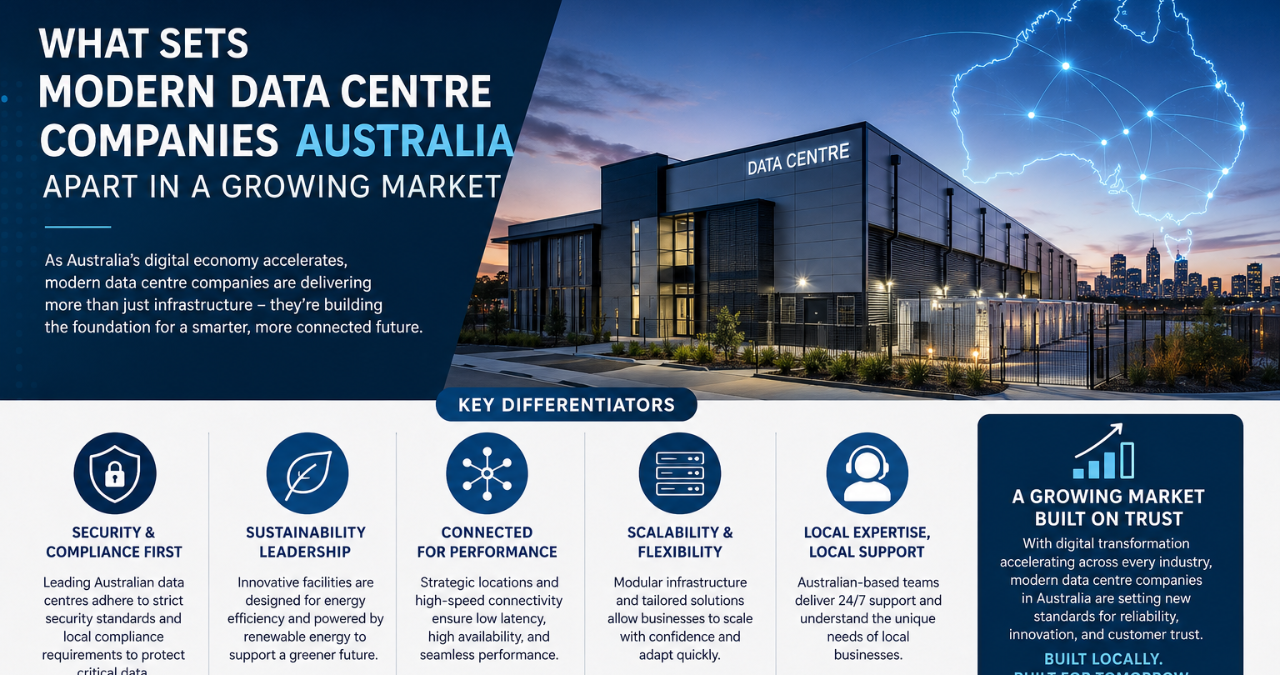
Not every operator competing for space in Australia’s infrastructure boom is built the same. Data centre companies Australia range from boutique regional providers with a single facility to global operators running multi-campus portfolios with billions in assets under management. The gap between them is not just size. It is technical capability, financial resilience, and the ability to serve increasingly complex enterprise and hyperscale requirements. Australia’s data centre revenue is projected to reach USD 3.9 billion by 2028. Knowing what separates genuine leaders from the field matters now more than ever.
What Technical Standards Do Leading Operators Actually Meet?
Tier certification is the clearest baseline. The Uptime Institute’s Tier III standard requires N+1 redundancy across all mechanical and electrical systems. Every UPS, every chiller, every power distribution unit has a backup that can carry the full load if the primary fails.
Leading operators go further. NEXTDC’s flagship facilities hold Tier IV design and construction certification, which requires 2N redundancy. That means two complete, independent systems for every critical component. The annual downtime allowance at Tier IV is 26.3 minutes. At Tier III it is 1.6 hours. For a financial services client processing millions of transactions daily, that difference is significant.
How Do Top Operators Handle Network Interconnection?
Network density is a differentiator that does not show up on a data sheet. The number of carriers, ISPs, and cloud on-ramps available inside a facility directly affects a tenant’s latency, redundancy options, and cost.
Equinix’s Sydney facilities host over 300 network service providers. That density means a tenant can switch providers without moving physical infrastructure. It also means direct private connectivity to cloud platforms without traffic touching the public internet, which reduces latency and improves security.
Operators without that interconnection depth force tenants to rely on a limited set of providers. That creates dependency and limits flexibility as workloads scale.
What Financial Backing Signals a Serious Long-Term Operator?
Data centres are capital-intensive and long-lived assets. A facility built today will serve customers for 20 to 30 years. The operator’s financial structure matters because tenants sign multi-year contracts and need confidence the facility will still be operating and investing in maintenance and upgrades in year ten.
The USD 24 billion Blackstone acquisition of AirTrunk in 2024 is a signal of institutional confidence in Australian data centre infrastructure. Similarly, NEXTDC has maintained investment-grade credit ratings and consistent capital market access, which underpins its ability to fund new campuses.
Smaller operators funded primarily by debt without institutional backing carry more risk, particularly in a rising interest rate environment. That risk gets passed to tenants indirectly, through delayed maintenance, slower capacity upgrades, or in extreme cases, ownership changes that disrupt service agreements.
How Are Leading Operators Addressing the AI Infrastructure Shift?
The best operators started preparing for AI workloads before their tenants asked for them. That means designing power distribution to support 30 to 100kW per rack, installing in-row liquid cooling infrastructure, and upgrading floor load ratings to handle denser hardware configurations.
Goodman Group announced a dedicated focus on data centre development with a specific emphasis on AI-ready campuses in its 2024 investor presentations. Positioning early means being able to serve GPU cluster deployments as demand materialises rather than scrambling to retrofit facilities after the fact.
What Customer Support Models Separate the Best From the Rest?
Response time matters. The best operators publish and contractually commit to Mean Time to Repair (MTTR) figures. A 15-minute MTTR commitment for power or cooling incidents is realistic for a well-staffed facility. Facilities that cannot commit to specific MTTR figures are usually telling you something about their staffing model.
Remote hands services and 24/7 on-site technical support are standard at leading facilities. What separates the top tier is proactive monitoring. Operators using AI-driven infrastructure monitoring can identify potential failures before they cause outages. That predictive capability is increasingly expected, not just appreciated.
Stay in touch to get more updates & news on Us Daily Hub!