
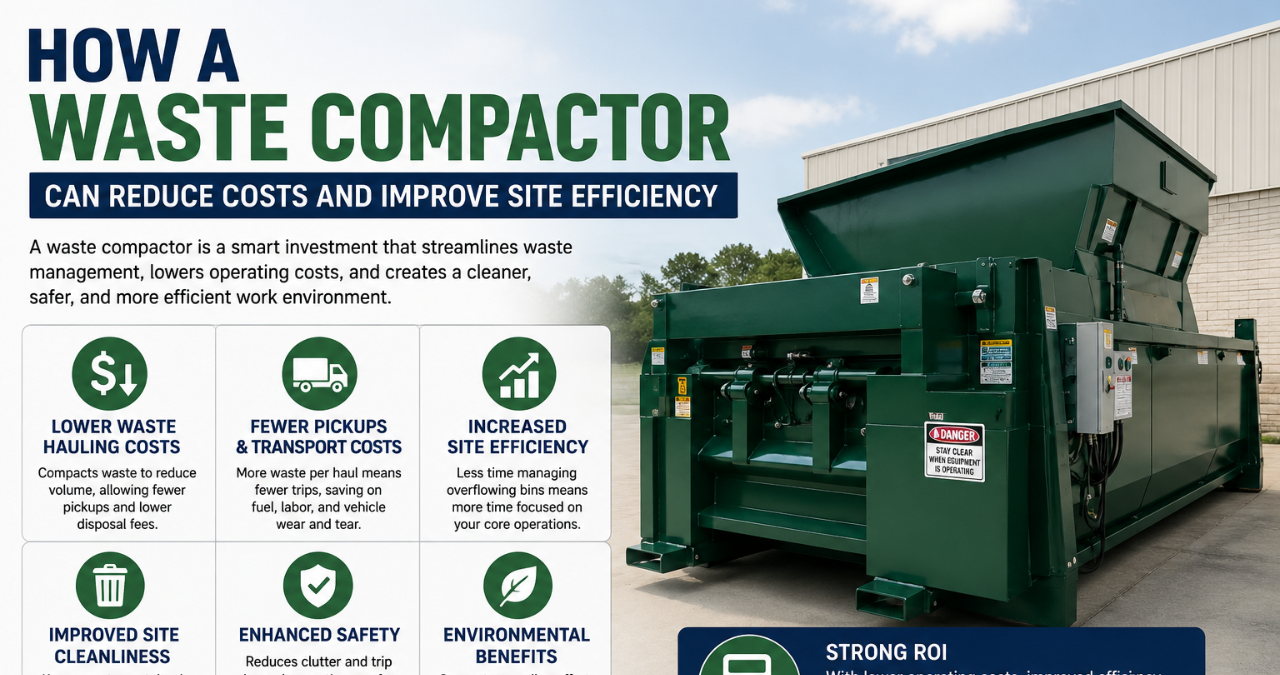
Every site has a waste problem. It just looks different depending on the industry. For some it is overflowing bins. For others it is constant truck fees or a loading dock that never seems clear. The fix is usually simpler than people think. A good waste compactor handles volume, reduces pickups, and clears the clutter that slows sites down. The cost savings are real. So are the efficiency gains. Here is the breakdown.
What Does a Waste Compactor Actually Do to Your Costs?
It cuts them. That is the short answer. The longer answer involves understanding where waste costs actually come from.
Most businesses think waste costs equal collection fees. They are wrong. The true cost includes staff time managing bins, space lost to overflow storage, and compliance penalties when waste gets out of hand.
According to Sustainability Victoria, commercial waste costs can be reduced by up to 40 percent with the right compaction setup. That is not a marginal improvement. That is a structural change to your operating costs.
How Does Compaction Improve Day-to-Day Site Efficiency?
Fewer pickups mean fewer disruptions. Every collection requires access. Trucks block entry points. Staff stop what they are doing. Work slows.
A site running six weekly collections might drop to one or two with a compactor in place. That is four to five fewer disruption events per week.
Compaction also keeps waste contained. Scattered rubbish is a safety hazard. Trip risks. Fire risks. Blocked emergency exits. A compactor eliminates the source of all three.
Which Industries See the Fastest ROI?
Retail, logistics, food manufacturing, and healthcare top the list. These industries produce consistent, high-volume waste streams that respond well to compaction.
A distribution centre processing 500 pallets per day generates a significant cardboard stream. Without compaction, that cardboard needs constant management. With compaction, it gets compressed, stored, and collected efficiently.
Healthcare facilities deal with both general and regulated waste. Compactors designed for healthcare environments handle the volume while meeting AS/NZS waste management standards for medical facilities.
Does Compaction Help With Environmental Reporting?
Yes. This matters more than it used to. The Australian Government’s National Packaging Targets require businesses to increase recycling and reduce landfill contribution. Reporting on that progress requires data.
Modern compactors integrate with waste tracking systems. They log volume, collection frequency, and weight data automatically. That data feeds directly into sustainability reports.
Businesses with ESG commitments or large retail clients increasingly need this evidence. A compactor gives you the data to prove your performance, not just claim it.
What Are the Key Specs to Look for in a Waste Compactor?
Compaction force is the first number. Measured in tonnes, this tells you how hard the machine presses. Most commercial units range from 10 to 30 tonnes of force. Higher force means better ratios for dense materials.
Container size is the second. Standard containers range from 10m³ to 30m³. Match the container to your production volume, not your current bin size.
Cycle time matters too. A compactor that takes 90 seconds per cycle slows the workflow. Units with 30 to 45 second cycles keep pace with busy sites without creating a bottleneck.
Stay in touch to get more updates & news on Us Daily Hub!