
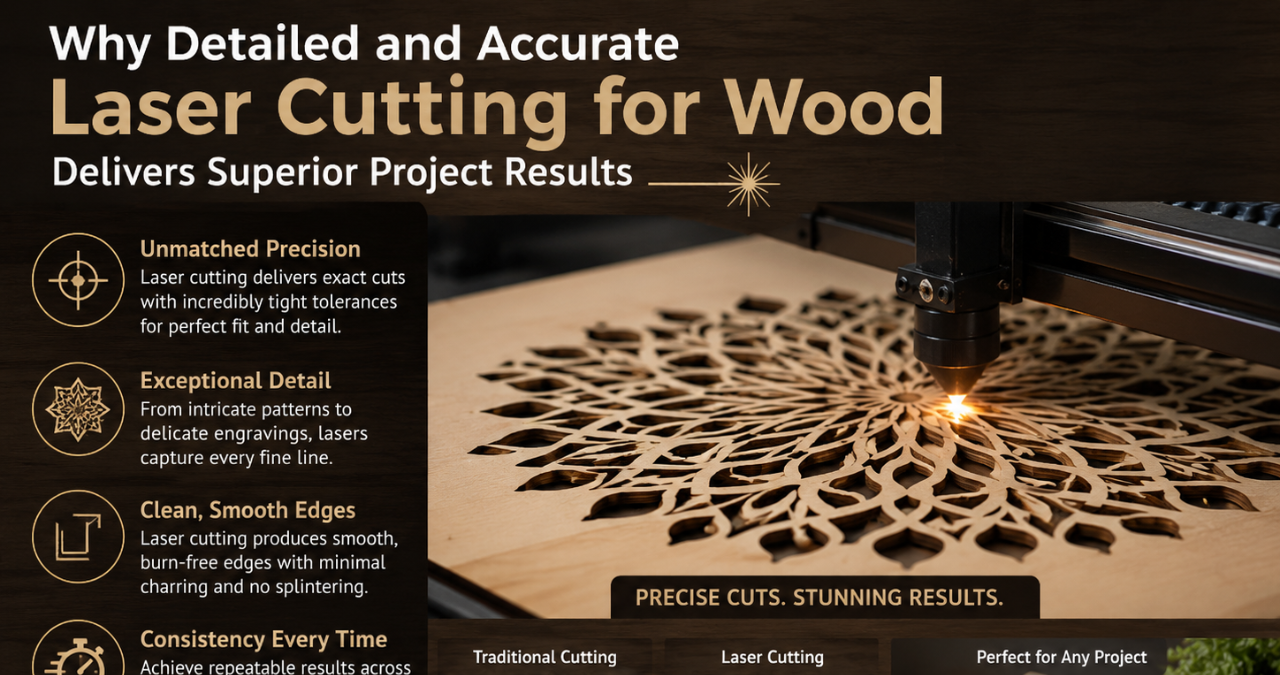
Wood is tricky. It has grain, knots, and moisture inside it. One plank cuts clean. The next one chars. That is why detailed and accurate laser cutting for wood is not a fancy phrase. It is the real reason your furniture parts fit, your signs look sharp, and your panels do not crack at the edges. CO2 lasers run at 40 to 150 watts for most wood jobs. They cut up to 25mm thick. That is real range, not a guess.
What Makes Wood So Hard To Cut Right?
Wood is alive, even after it is cut down. It holds water. It has rings. Some spots are dense. Some spots are soft. A laser beam does not care about any of that. It just burns through. So if the settings are wrong, you get charring on one side and a clean edge on the other. That is not bad luck. That is bad calibration. A skilled operator slows down near knots and speeds up on straight grain. That is pattern reading, done fast, on the fly.
Why Does Kerf Width Actually Matter Here?
Kerf is the strip of wood the laser burns away. For wood and plastics, kerf usually sits between 0.25mm and 0.51mm. That sounds small. It is not. Stack that error across ten parts that need to fit together, and your project is now off by millimeters. A drawer front will not sit flush. Good shops build kerf into the file before they hit cut. That is the line between a hobby project and a real one.
Does Plywood Behave Differently Than Solid Timber?
Completely differently. Plywood is glued layers of veneer. It is stable. It does not warp the way solid wood does. That is why most shops favor MDF-core, birch, or poplar plywood for signage and architectural panels. Solid timber moves with humidity. Plywood barely moves at all. If your project needs to hold its shape for years, plywood usually wins.
What Happens If The Settings Are Even Slightly Off?
Charring spreads. Edges go dark brown instead of clean tan. Worse, the structure weakens. A laser that runs too slow burns deeper than it should. One that runs too fast does not finish the cut, so the part tears free instead of dropping clean. Neither result is acceptable on a paid job. Frequency matters too. Wood cuts best around 500 to 1000 Hz. Acrylic needs thousands more. Mixing those up wrecks the material fast.
Why Does Non Contact Cutting Actually Protect The Wood?
A laser never touches the material. No blade, no friction, no clamping pressure. That means no splintering, no chipping at corners, no warping from a blade pushing through grain. This matters most on thin veneers, where one mechanical slip ruins the sheet. Laser cutting also fuses the surface fibers as it passes, leaving a slightly sealed edge most people do not expect until they feel it.
Can A Laser Cut Shapes That Saws Cannot?
Easily. Tight inner corners, fine lettering, lace-like screen patterns. A blade needs room to turn. A laser beam does not. Tolerances on a well-tuned system land around plus or minus 0.1mm, the kind of accuracy that lets dozens of identical parts come off the same file without rechecking each one by hand.
Is Accuracy Worth Paying More For?
Every time. A cheap cut that is slightly off costs more later, in rework, wasted material, and delays. Precision upfront beats repair after the fact, almost always.
Stay in touch to get more updates & news on Us Daily Hub!