
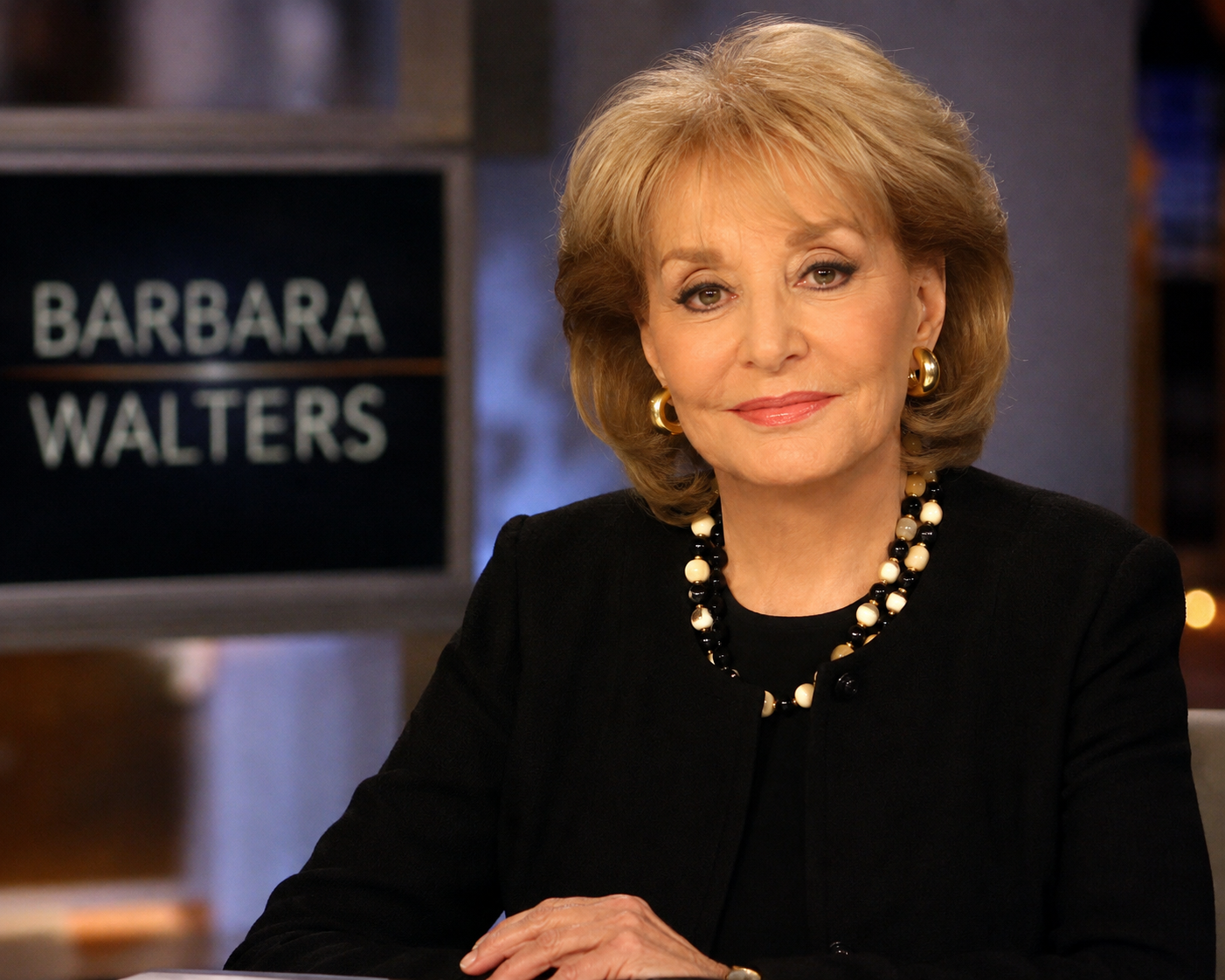
Barbara Walters was one of the most influential journalists in American television history. Known for her calm but direct interviewing style, remarkable preparation, and ability to speak with presidents, celebrities, royalty, and other major public figures, she built a career that lasted for decades. More importantly, barbara walters became a symbol of opportunity for women who wanted to work in broadcast journalism.
Born in Boston, Massachusetts, on September 25, 1929, Walters entered television at a time when women were often given limited roles on news programs. She gradually moved from writing and research into reporting, interviewing, anchoring, and producing. In 1974, she became the first woman to officially serve as co-host of NBC’s Today. Two years later, she made another major breakthrough by becoming the first female co-anchor of a network evening news program.
Her career later included 20/20, the famous Barbara Walters Specials, and The View, the daytime program she helped create in 1997. She died on December 30, 2022, at the age of 93, but her influence continues to be seen across television journalism.
Barbara Walters Quick Information Table
| Topic | Information |
|---|---|
| Full name | Barbara Jill Walters |
| Born | September 25, 1929 |
| Birthplace | Boston, Massachusetts, USA |
| Died | December 30, 2022 |
| Age at death | 93 |
| Education | Sarah Lawrence College |
| Main profession | Broadcast journalist, interviewer, television personality, producer |
| Major networks | NBC and ABC |
| Famous programs | Today, 20/20, The Barbara Walters Specials, The View |
| Major achievement | First female co-anchor of a network evening news program |
| The View | Creator, executive producer, and co-host |
| Career span | More than five decades |
| Known for | High-profile interviews and television journalism |
Barbara Walters Early Life and Education
Barbara Jill Walters was born into a family connected to show business. Her father, Lou Walters, worked in entertainment and was associated with the famous Latin Quarter nightclub business. Growing up around performers and public life gave Walters an early understanding of audiences, communication, and the world of entertainment.
Her childhood wasn’t always simple. Her family experienced both success and difficult periods, and Walters later spoke openly about how her upbringing shaped her personality. She learned early that life could change quickly. That experience may have helped her develop the confidence and adaptability that became important throughout her professional life.
Walters attended Sarah Lawrence College in New York, where she studied English. After college, she entered the working world and began building experience in television. According to the Television Academy, she first became known professionally during the early 1960s through her work as a writer and segment producer on NBC’s Today.
At first glance, this might seem like a modest beginning for someone who would later interview world leaders. Yet that’s precisely what made her story so remarkable. She didn’t walk into television as a major star. She worked her way upward, learning the business step by step.
Barbara Walters Begins Her Television Career
Before becoming a household name, Walters worked behind the scenes and developed valuable writing and production skills. Her early experience taught her how television stories were planned, researched, written, edited, and presented.
In 1961, NBC hired Walters as a writer and researcher for Today. At the time, women on television news were often expected to focus on subjects considered more suitable for female audiences. Walters wasn’t satisfied with staying inside those boundaries.
She pushed for better assignments and gradually became an on-air reporter. One important early opportunity came when she traveled with First Lady Jacqueline Kennedy on an international trip. Her reporting helped demonstrate that she could handle serious subjects as well as lighter television features.
Her progress wasn’t automatic. Walters worked during an era when television news was heavily dominated by men. She later described the restrictions placed on women reporters, including limitations on the types of questions they could ask and the stories they could cover.
But Walters kept going.
That’s an important part of her story. Her success wasn’t simply the result of being in the right place at the right time. She repeatedly asked for opportunities and proved she was capable of handling them.
Barbara Walters and the Today Show
Walters became increasingly important to Today during the 1960s and 1970s. She was initially given assignments that were often focused on lifestyle or women’s interests, but she worked to expand her role.
Her interviewing ability quickly became one of her greatest strengths. She had a natural talent for making conversations interesting while still asking direct questions.
By the mid-1960s, Walters had become a regular presence on Today. She was sometimes referred to as the “Today girl,” a label that reflected the gender expectations of the period. However, her actual responsibilities were becoming much broader.
In 1974, NBC officially made Walters a co-host of Today. The Television Academy identifies this as an important milestone because she became the first woman to hold such a title on an American news program.
Her achievement was about more than one television job. It showed audiences and television executives that a woman could play a central role in a major national news program.
Walters later left NBC for ABC in 1976. That move opened the door to one of the most important chapters of her career.
Barbara Walters Makes History at ABC
In 1976, Walters joined ABC News and became the first female co-anchor of a network evening news program. She worked with Harry Reasoner on the ABC Evening News.
The move attracted enormous attention. Walters was not only breaking a professional barrier; she was also entering a highly competitive environment in which women were still underrepresented in major anchor positions.
Her reported salary also became a major story. She was widely reported as becoming the first news anchor to receive a salary of one million dollars a year, which was extraordinary for the time. Her compensation became part of the public conversation about women’s value in television.
The evening news partnership didn’t become the defining success of her career, but the historical importance of the appointment was undeniable.
She had reached one of the most prestigious positions in American television news.
And she wasn’t finished.
Barbara Walters and 20/20
One of the most important parts of Walters’ career came through ABC’s 20/20. She became a major figure on the program and spent many years as a co-host and chief correspondent.
ABC has described Walters as a 20/20 co-host and chief correspondent for 25 years. The program became a place where she could combine investigative reporting, news coverage, human-interest stories, and long-form interviews.
Her role on 20/20 helped establish her as one of television’s most recognizable interviewers.
Unlike a short news interview, long-form television allowed Walters to spend more time with her subjects. She could ask a question, listen carefully, follow up, and then move into another subject based on the person’s response.
That approach became one of her trademarks.
The modern interview format can sometimes feel fast and heavily edited. Walters often showed the value of simply allowing a conversation to develop. She understood that the strongest question wasn’t always the most dramatic one. Sometimes the best question was a simple follow-up that encouraged someone to explain what they really meant.
Barbara Walters and Her Famous Interviews
When people discuss barbara walters, her interviews are usually one of the first things that come to mind.
Throughout her career, Walters interviewed a remarkable range of people. Her subjects included presidents, first ladies, political leaders, entertainers, athletes, business figures, and other famous personalities.
ABC has noted that she interviewed every U.S. president and first lady from Richard and Pat Nixon through Barack and Michelle Obama, as well as Donald and Melania Trump during the 2016 presidential campaign.
Her interviews were often memorable because she wasn’t afraid to ask uncomfortable questions.
At the same time, she usually tried to keep the conversation moving rather than turning every interview into an argument. She wanted information, but she also wanted to understand the person sitting across from her.
What made her interview style different?
Several qualities helped define Walters’ approach:
- Preparation: She researched her guests carefully.
- Direct questions: She didn’t always avoid sensitive subjects.
- Follow-up questions: She listened to answers instead of simply reading a list.
- Calm delivery: Her voice often remained controlled even during difficult conversations.
- Curiosity: She tried to understand what motivated people.
- Human interest: She often explored the personal side of public figures.
- Adaptability: She could interview a political leader and then speak with a major entertainer.
Her style influenced generations of journalists and interviewers.
Barbara Walters and The Barbara Walters Specials
Another major part of her legacy came through The Barbara Walters Specials. These programs gave her a platform for extended interviews and conversations with major personalities.
The specials became closely associated with her name. They also demonstrated how a journalist could become a trusted television brand without giving up the importance of serious interviewing.
Walters was able to move between journalism and popular culture in a way few television personalities could match.
One minute, she might be discussing world politics. The next, she could be interviewing a movie star about family, fame, or personal challenges.
That range was part of her appeal.
She understood something important about television: audiences want information, but they also want to understand people.
Barbara Walters Creates The View
In 1997, Walters helped create The View, a daytime talk show built around conversations among women with different backgrounds and opinions.
The concept was simple but powerful. Instead of having a single host control every discussion, the program created a table where several women could debate current events, culture, entertainment, family matters, and other subjects.
ABC describes Walters as the creator, executive producer, and co-host of The View.
The program became an important part of daytime television and continued long after Walters left the regular panel.
The show’s basic concept has also remained recognizable: women with different viewpoints sitting together, discussing major topics, disagreeing at times, and sharing personal experiences.
In 2022, ABC described The View as a forum Walters created in 1997 where women discuss everyday issues, express opinions, and talk about important subjects of the day.
That’s quite a legacy for a program that started more than two decades earlier.
Barbara Walters’ Role as a Pioneer for Women
Perhaps Walters’ greatest achievement wasn’t a single interview or television program.
It was the path she created for other women.
When Walters began her career, women faced significant barriers in television journalism. Major anchor positions were overwhelmingly occupied by men. Women were frequently expected to cover lifestyle subjects rather than politics, business, or major international events.
Walters challenged those assumptions through persistence and performance.
She demonstrated that a woman could:
- Anchor a major national news program
- Interview presidents and political leaders
- Cover international events
- Host a long-running newsmagazine
- Lead major television specials
- Create a successful talk show
- Become a television producer
- Build a lasting professional reputation
ABC has specifically described Walters as a trailblazer who paved the way for women in broadcast journalism.
Her career also helped change audience expectations. Once viewers became accustomed to seeing women ask serious questions on national television, the old argument that women couldn’t handle major news became harder to defend.
In that sense, Walters didn’t simply take a seat at the table.
She helped make the table bigger.
Barbara Walters’ Awards and Professional Recognition
Walters received extensive recognition during her career. Her work earned multiple Emmy Awards and other honors.
The Television Academy recognizes her as an important figure in American television journalism and highlights her historic achievements at Today and ABC News.
In 2009, she received the News & Documentary Emmy Lifetime Achievement Award. ABC News described the honor as recognition for her lifetime of work as an iconic journalist and interviewer.
Her awards matter because they show that her success wasn’t based only on popularity. She was also recognized by the television industry for professional achievement.
Some notable areas of recognition include:
- Emmy Awards
- News & Documentary Emmy Lifetime Achievement Award
- Daytime Emmy recognition connected with The View
- Television Critics Association Career Achievement Award
- Hollywood Walk of Fame star
- Other professional honors
Her career became a model of how journalism, television production, and interviewing could work together.
Barbara Walters Personal Life
While Walters became famous for asking other people personal questions, she generally kept parts of her own private life away from the spotlight.
She was married several times and had one daughter, Jacqueline, whom she adopted with her former husband Lee Guber. Her family life was sometimes discussed publicly, particularly as Walters spoke about the challenge of balancing motherhood with an intense television career.
Her personal experiences helped show another side of her public identity. She was not simply a television personality chasing the next major interview. She was also a mother and a person dealing with the demands of an unusually high-pressure career.
In later reflections, Walters acknowledged that professional success could come with personal sacrifices.
That’s one reason her story remains relatable despite her extraordinary fame.
Barbara Walters Retirement From Television
Walters gradually reduced her regular television work before formally stepping away from her long-running role on The View in 2014.
Her final period on the program became an emotional moment in television. ABC later highlighted how female journalists gathered to honor the woman who had helped open doors for them.
Retirement didn’t erase her influence.
Instead, it gave viewers an opportunity to look back at the enormous distance she had traveled.
She had entered television when women were frequently placed in limited roles. Decades later, she had become one of the most recognizable journalists in the country.
That’s no small feat.
Barbara Walters Later Years and Death
Barbara Walters died on December 30, 2022, at the age of 93. ABC News and the Television Academy both record her dates as September 25, 1929, to December 30, 2022.
Following her death, ABC aired tributes celebrating her life and career. Our Barbara: A Special Edition of 20/20 featured reflections from colleagues and people who knew her, along with archival material from her career.
The tributes made one thing clear: Walters’ importance extended far beyond her television appearances.
She had become part of the history of American broadcasting.
Barbara Walters’ Legacy in Modern Journalism
The influence of barbara walters can still be seen in television journalism today.
Women now occupy many major roles as anchors, correspondents, interviewers, political journalists, producers, and network executives. The media landscape has changed dramatically, with cable news, podcasts, social media, streaming services, and digital journalism creating new opportunities.
Yet the basic skill Walters mastered remains important:
Ask good questions and listen to the answers.
That sounds simple, but it’s harder than it looks.
A strong interviewer must understand the subject, recognize important details, notice contradictions, and know when a follow-up question is necessary. Walters developed these skills over many years.
Her career also showed the importance of preparation. A good interview doesn’t begin when the camera turns on. It begins with research, background knowledge, and an understanding of what the audience needs to learn.
Lessons From Barbara Walters’ Career
There are several useful lessons readers can take from Walters’ professional journey.
Persistence matters
Walters faced barriers throughout her career, but she continued pursuing better opportunities.
When one door wasn’t open, she looked for another way forward.
Preparation creates confidence
Her interviews were known for their preparation. Knowing the subject allowed her to ask meaningful questions rather than relying on surface-level conversation.
Don’t accept limiting labels
Walters was initially placed into roles considered suitable for women at the time. She worked beyond those expectations.
Her career shows that labels don’t have to determine someone’s future.
Communication is a powerful skill
Whether you’re a journalist, business owner, student, or professional, knowing how to communicate clearly can create opportunities.
Success can create opportunities for others
Walters’ success mattered not only because of what she achieved personally. Her career helped demonstrate that women could succeed in positions that had previously been dominated by men.
Why Barbara Walters Still Matters Today
In today’s media environment, famous interviews can spread across the internet within minutes. Social media has changed how public figures communicate with audiences, and celebrities can often speak directly to millions of followers without using traditional television.
Even so, professional interviewing remains important.
Walters understood how to create an event around a conversation. Her interviews attracted attention because viewers wanted to hear what important people would say when asked questions by someone who was prepared and persistent.
Her influence is also visible in the continued popularity of The View. The program has survived many changes in hosts, politics, television technology, and audience habits. ABC has continued to describe the show as the forum Walters created in 1997.
That lasting presence says a lot about her original idea.
Barbara Walters and Her Continuing Cultural Impact
Walters’ story continues to receive attention through documentaries, television specials, interviews, and archival material.
In 2025, ABC highlighted Barbara Walters Tell Me Everything, a feature-length documentary examining her career, personal life, challenges, and influence on journalism. The documentary includes archival footage and interviews with people who knew or worked with her, including Oprah Winfrey, Katie Couric, Connie Chung, Joy Behar, and others.
The documentary is significant because it shows that interest in Walters didn’t disappear after her death.
New generations can still study her career and understand how much television journalism changed during her lifetime.
For students interested in journalism, her story provides a useful example of professional growth. For women entering media, it offers an especially powerful lesson about persistence and leadership.
Frequently Asked Questions About Barbara Walters
Who was Barbara Walters?
Barbara Walters was an American broadcast journalist, interviewer, television personality, and producer. She became famous through Today, ABC News, 20/20, her television specials, and The View.
What was Barbara Walters famous for?
She was especially famous for her high-profile interviews and for breaking barriers for women in television journalism.
Was Barbara Walters the first female evening news anchor?
She became the first female co-anchor of a network evening news program when she joined ABC in 1976.
When did Barbara Walters join Today?
Walters joined NBC’s Today as a writer and researcher in 1961. She later became a reporter and eventually an official co-host in 1974.
What did Barbara Walters create?
Walters helped create The View, which premiered in 1997. She served as a creator, executive producer, and co-host.
When did Barbara Walters die?
Barbara Walters died on December 30, 2022, at the age of 93.
What made Barbara Walters a successful interviewer?
Her success came from preparation, curiosity, direct questions, careful listening, and her ability to connect with many different types of people.
Final Thoughts on Barbara Walters
Barbara Walters left behind a career that changed the history of American television. She began at a time when women were often given limited opportunities in broadcasting, yet she continued to push forward until she reached positions that had rarely been available to women before.
From Today to ABC News, from 20/20 to her famous interview specials, and finally to The View, her career demonstrated the power of persistence, preparation, courage, and communication. She wasn’t perfect, and her career had its share of challenges and criticism, but her professional achievements remain remarkable.
Most importantly, barbara walters helped change what audiences expected from women in television. She proved that women could lead serious news programs, interview powerful people, create successful shows, and shape the direction of broadcasting itself. Her influence continues through the journalists, interviewers, producers, and television personalities who followed the path she helped create.
In the end, barbara walters wasn’t simply a famous television journalist. She was a pioneer whose work helped make the broadcasting industry more open, more diverse, and more willing to recognize women’s voices.
Stay in touch to get more updates & news on Us Daily Hub!