
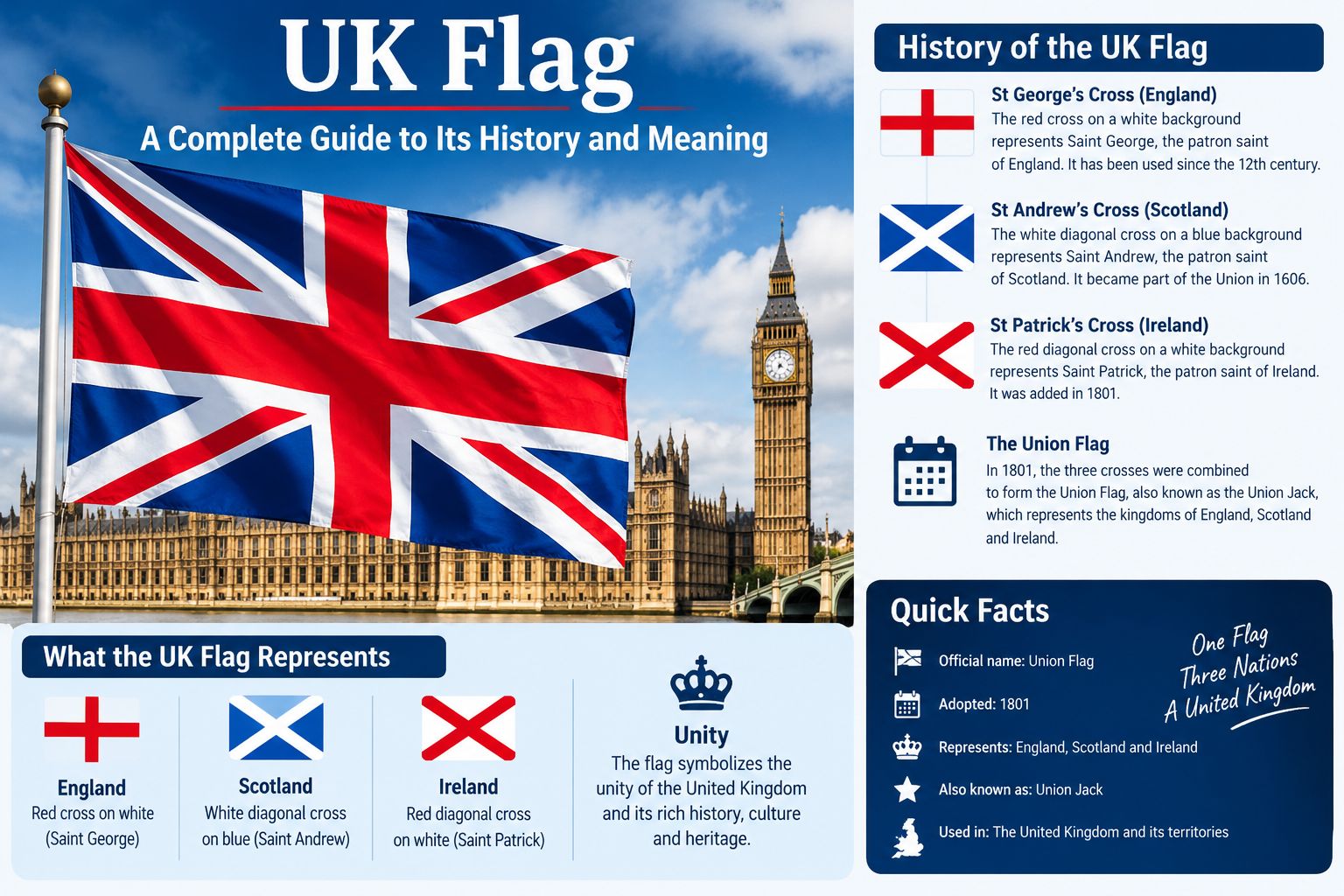
The uk flag is one of the most recognizable national flags in the world. Its strong red, white, and blue design can be seen on government buildings, public events, sports grounds, ships, souvenirs, and many other places. Although the design may look simple at first, it carries centuries of history and represents the political and cultural connections that helped shape the United Kingdom.
The flag is commonly known as the Union Flag, while the name Union Jack is also widely used. Its design brings together symbols linked with England, Scotland, and Ireland. Wales is not separately shown on the flag because of the historical way Wales became part of the Kingdom of England before the first Union Flag was created.
Learning about this famous flag is an interesting way to understand British history. Its colors, crosses, shape, and development are all connected to important events. From royal history and political unions to naval traditions and modern celebrations, the flag has remained an important national symbol.
What Is the UK Flag?
The uk flag is the national flag of the United Kingdom of Great Britain and Northern Ireland. It is made from several traditional crosses that were brought together over time.
The United Kingdom consists of four nations:
- England
- Scotland
- Wales
- Northern Ireland
The design directly includes symbols associated with England, Scotland, and Ireland. However, Wales does not have a separate symbol on the Union Flag. This is because the history of the flag began after Wales had already been legally incorporated into the Kingdom of England.
The main parts of the design are easy to recognize. There is a large red upright cross, a white diagonal cross, and a red diagonal cross placed over a deep blue background. These elements create the famous pattern that people around the world associate with Britain.
The flag isn’t simply a decorative design. Each major element has a historical connection, making it a useful visual reminder of the unions that shaped the British state.
UK Flag and Its Early History
The story of the uk flag begins in the early seventeenth century. In sixteen-oh-three, James VI of Scotland also became James I of England following the death of Queen Elizabeth I. This event is known as the Union of the Crowns because England and Scotland now shared the same monarch.
England and Scotland were still separate kingdoms at that time. However, sharing a monarch created a new political relationship between them. A need eventually developed for a symbol that could represent the two kingdoms under one crown.
In sixteen-oh-six, a new flag was introduced. It combined the red Cross of St George, associated with England, with the white Saltire of St Andrew, associated with Scotland.
This first Union Flag looked different from the modern version. Ireland was not included in the design at that point, and the political structure of the United Kingdom had not yet developed into its present form.
The early flag was particularly connected with ships and maritime use. Britain would later become a major naval power, helping the Union Flag become familiar far beyond the British Isles.
How the UK Flag Developed Over Time
The modern uk flag is the result of several stages of British history rather than one single event.
The first major stage came with the Union of the Crowns. England and Scotland had the same monarch, but they remained separate kingdoms. The creation of the first Union Flag reflected their shared monarchy.
A major political change followed in seventeen-oh-seven. The Acts of Union united England and Scotland into the Kingdom of Great Britain. The earlier Union Flag continued to be used.
Another major change occurred in eighteen-oh-one. Great Britain and Ireland were united under one kingdom, creating the United Kingdom of Great Britain and Ireland. A new Union Flag was introduced to reflect this political union.
The Irish element was added through the red Saltire traditionally associated with St Patrick. This produced the basic design that is still recognized today.
Later, most of Ireland became independent, while Northern Ireland remained part of the United Kingdom. The Union Flag itself continued to be used.
A Simple Historical Overview
| Historical period | Major development |
|---|---|
| Early seventeenth century | England and Scotland shared a monarch |
| Sixteen-oh-six | First Union Flag combined English and Scottish symbols |
| Seventeen-oh-seven | England and Scotland became Great Britain |
| Eighteen-oh-one | Ireland was added to the Union Flag |
| Modern era | The current design remains the national flag of the UK |
This gradual development makes the flag particularly interesting because its design is closely connected to constitutional and political history.
UK Flag Design and Its Symbols
The uk flag contains several important visual elements. Understanding these parts makes it easier to understand why the flag looks the way it does.
The Cross of St George
The large red cross is the Cross of St George. It is associated with England and is also found on the English national flag.
The cross runs vertically and horizontally across the center of the design. Its strong shape gives the flag much of its visual structure.
The Saltire of St Andrew
The white diagonal cross is known as the Saltire of St Andrew. It is associated with Scotland.
Unlike a traditional upright cross, a saltire forms an X shape. Scotland’s own national flag is based on this white saltire against a blue background.
The Saltire of St Patrick
The red diagonal cross is traditionally associated with St Patrick and Ireland. It was added to the Union design in eighteen-oh-one when Great Britain and Ireland were politically united.
The red diagonal element is especially important because it helps create the distinctive appearance of the modern flag.
The Blue Background
The blue field provides the background for the crosses. It creates strong contrast with the red and white elements and gives the flag its familiar appearance.
Together, these components form a design that is both visually powerful and historically meaningful.
Why the Diagonal Design Is Asymmetrical
One detail that often surprises people is that the diagonal elements of the uk flag are not arranged as a perfectly balanced X.
This is intentional.
The white and red diagonal stripes have a specific arrangement. When the flag is displayed correctly, the wider white part of the diagonal design appears toward the upper side nearest the flagpole.
This detail helps distinguish the Scottish Saltire from the red Saltire associated with St Patrick. It also means that the flag should not be designed simply by placing two identical diagonal lines behind a central cross.
For someone drawing or printing the flag, this difference is important. A design that looks almost right can still be technically incorrect if the diagonal elements are placed in the wrong position.
The asymmetry is therefore not an accident or printing error. It is an important feature of the traditional design.
UK Flag and the Name Union Jack
The uk flag is commonly called the Union Jack. Both names are familiar to people in Britain and around the world.
The term Union Flag is often preferred in formal discussions about the national flag. However, Union Jack is a very common everyday name.
The word “Jack” has historical connections with maritime flags. A jack was a flag flown from a short staff on the front part of a ship. Because the Union Flag was closely associated with British naval use, the name Union Jack became established over time.
Today, most people understand Union Jack and Union Flag to mean the same national design.
This is a good example of how language can develop alongside history. A term that originally had a specific naval connection eventually became a common name for one of the world’s best-known flags.
The Role of the UK Flag in National Identity
The uk flag has a strong connection with British identity. It can represent the United Kingdom as a whole and is often used during national events and international competitions.
For many people, the flag represents:
- National pride
- Shared history
- Unity
- Tradition
- Public service
- British culture
However, national identity is complex. People may have different views about the flag because they have different cultural, political, or historical experiences.
Some people see it mainly as a symbol of unity and national pride. Others may think about Britain’s long imperial history when they see it. Both reactions are part of the wider historical discussion surrounding national symbols.
A thoughtful approach is to understand the history of the flag before deciding what it means personally. Symbols can have different meanings for different communities, and learning about those meanings can encourage respectful discussion.
UK Flag and Wales
A common question about the uk flag is why there is no Welsh dragon in the design.
The answer is connected to history.
When the first Union Flag was created in the early seventeenth century, Wales had already become part of the Kingdom of England through earlier political and legal changes. As a result, Wales was not treated as a separate kingdom in the same way as Scotland.
The Welsh dragon therefore does not appear on the Union Flag.
Wales does, however, have its own national flag. It features a large red dragon on a background of green and white. This flag remains an important symbol of Welsh national identity.
The absence of the dragon doesn’t mean Wales is unimportant within the United Kingdom. Instead, it reflects the historical circumstances in which the Union Flag was created.
Understanding this point can prevent one of the most common misunderstandings about the British flag.
How the UK Flag Is Used Today
The uk flag remains highly visible in modern British life.
It can be found on government buildings, public institutions, sporting venues, ships, monuments, clothing, books, souvenirs, and event decorations.
Government buildings may display the Union Flag on designated occasions and, under current UK government guidance, it is encouraged to be flown on government buildings throughout the year.
The flag is also especially noticeable during international sporting competitions. British athletes and teams may use it when representing the United Kingdom, making the design familiar to millions of viewers.
During national celebrations, the flag can appear on streets, public buildings, and private homes. It may also be used during royal events and important ceremonies.
Its continued presence shows how a historic symbol can remain relevant in modern society.
UK Flag in Maritime History
The uk flag has a strong connection with the sea.
The earliest Union Flag was closely associated with naval use. British ships carried the flag during a period when Britain’s maritime influence was expanding rapidly.
Over time, British naval traditions helped spread the design to different parts of the world. Ships were among the most visible ways national flags could travel across oceans, particularly before modern communication systems existed.
This maritime history also explains why the term Union Jack became popular.
The connection between the flag and the sea remains an important part of its story. Even today, the Union Flag can be seen in maritime settings, naval traditions, historical displays, and museums.
The UK Flag Around the World
The uk flag has had a major influence on flag design in other countries and territories.
Because of Britain’s historical global connections, the Union Flag became part of several national and territorial flags.
Examples include:
- Australia
- New Zealand
- Fiji
- Tuvalu
It also appears in the flags of several British Overseas Territories.
This international influence doesn’t mean that these places have identical identities. Instead, the presence of the Union Flag in their designs reflects historical relationships with Britain.
For students of vexillology, the study of flags, the Union Flag is particularly interesting because its design demonstrates how political relationships can influence national symbols.
It is also a useful example of how one flag design can become part of several different visual traditions.
How to Display the UK Flag Properly
Displaying the uk flag correctly is important, particularly in official or formal settings.
A few basic principles can help:
- Use a flag with the correct design.
- Make sure it is facing the right direction.
- Keep the material clean and in reasonable condition.
- Avoid allowing the flag to become unnecessarily damaged.
- Follow official rules when displaying it on public buildings.
- Use suitable proportions for the intended purpose.
The direction of the flag is especially important. Because the diagonal elements are intentionally asymmetrical, turning the flag upside down changes the arrangement.
Many people don’t notice this immediately, but it becomes easier to recognize after studying the design carefully.
Common Misunderstandings About the UK Flag
The uk flag is familiar, but several myths and mistakes continue to appear.
It Represents Only England
This isn’t correct. The design combines historical symbols associated with several parts of the United Kingdom and its earlier political unions.
Wales Is Represented by the Dragon
The Welsh dragon does not appear on the Union Flag. Wales has its own separate national flag.
The Design Is Completely Symmetrical
The diagonal elements are intentionally asymmetrical. Their arrangement is an important part of the correct design.
The Modern Design Was Created in Sixteen-oh-six
The first Union Flag was created in sixteen-oh-six, but the current design developed in eighteen-oh-one after Ireland was added.
Union Jack Is Always an Incorrect Name
This is also misleading. Union Jack is a widely established name for the flag, although Union Flag is often preferred in formal contexts.
Clearing up these misunderstandings makes the history much easier to understand.
UK Flag in Education and Culture
The uk flag is a useful teaching tool because it connects geography, history, politics, art, and culture.
Teachers can use the flag to help students explore the history of the United Kingdom. Rather than asking students to memorize the colors, educators can explain the story behind each cross.
For example, students can compare the Union Flag with the individual flags of England, Scotland, Wales, and Northern Ireland. They can then study how political unions changed the appearance of the national symbol.
The design is also common in popular culture. It appears on clothing, posters, music-related products, tourist items, films, television programs, and sporting merchandise.
Because the colors and pattern are so recognizable, even a small part of the design can immediately suggest British culture.
Interesting Facts About the UK Flag
The uk flag has many fascinating facts connected with its history and design.
Here are some of the most useful ones to remember:
- The first Union Flag appeared in the early seventeenth century.
- The original design combined English and Scottish symbols.
- The modern design was introduced in eighteen-oh-one.
- The Irish element was added when Great Britain and Ireland were united.
- The flag has strong connections with British naval history.
- Union Flag and Union Jack are both widely used names.
- The diagonal elements are intentionally asymmetrical.
- Wales is not separately represented by the Welsh dragon.
- The design has influenced several other flags around the world.
- The flag remains widely used in modern Britain.
These facts demonstrate why this national symbol continues to attract interest from historians, students, travelers, designers, and flag enthusiasts.
Why the UK Flag Remains Important
The uk flag has survived centuries of political and social change. Governments have changed, borders have changed, and relationships between nations have changed, yet the familiar design remains an important symbol of the United Kingdom.
One reason for its continued importance is its ability to communicate identity quickly. A flag can be recognized from a distance, making it useful during public events, international competitions, ceremonies, and official occasions.
The flag also connects the present with the past. Looking at its crosses encourages people to ask questions about England, Scotland, Ireland, Wales, monarchy, political unions, and Britain’s wider history.
At the same time, understanding the flag doesn’t require everyone to have the same opinion about it. People can respect history while discussing its complicated parts honestly.
That balance is valuable. Learning about national symbols should encourage knowledge rather than simply promoting one viewpoint.
Final Thoughts on the UK Flag
The uk flag is much more than a familiar red, white, and blue design. It is a visual record of centuries of history and reflects the political relationships that helped create the modern United Kingdom.
Its development began with the union of the English and Scottish crowns and continued through the political union of Great Britain and Ireland. The crosses associated with England, Scotland, and Ireland were brought together to create a distinctive national symbol.
The flag’s history also explains why Wales does not have a separate place in the design, why the diagonal stripes are arranged in an unusual way, and why both Union Flag and Union Jack are commonly used names.
Today, the flag continues to appear at official ceremonies, sporting events, public buildings, cultural occasions, and international gatherings. Its influence can also be seen in several flags around the world.
Perhaps the most interesting thing about this symbol is that its meaning can continue to develop. For some people, it represents national pride and unity. For others, it is a reminder of Britain’s complicated past. Understanding both its achievements and its historical challenges gives readers a more complete view.
In the end, studying the uk flag is really an opportunity to study history itself. Its design tells a story of nations, unions, traditions, and changing identities. That story remains relevant today, making the uk flag an enduring and fascinating symbol of the United Kingdom.
Stay in touch to get more updates & news on Us Daily Hub!