
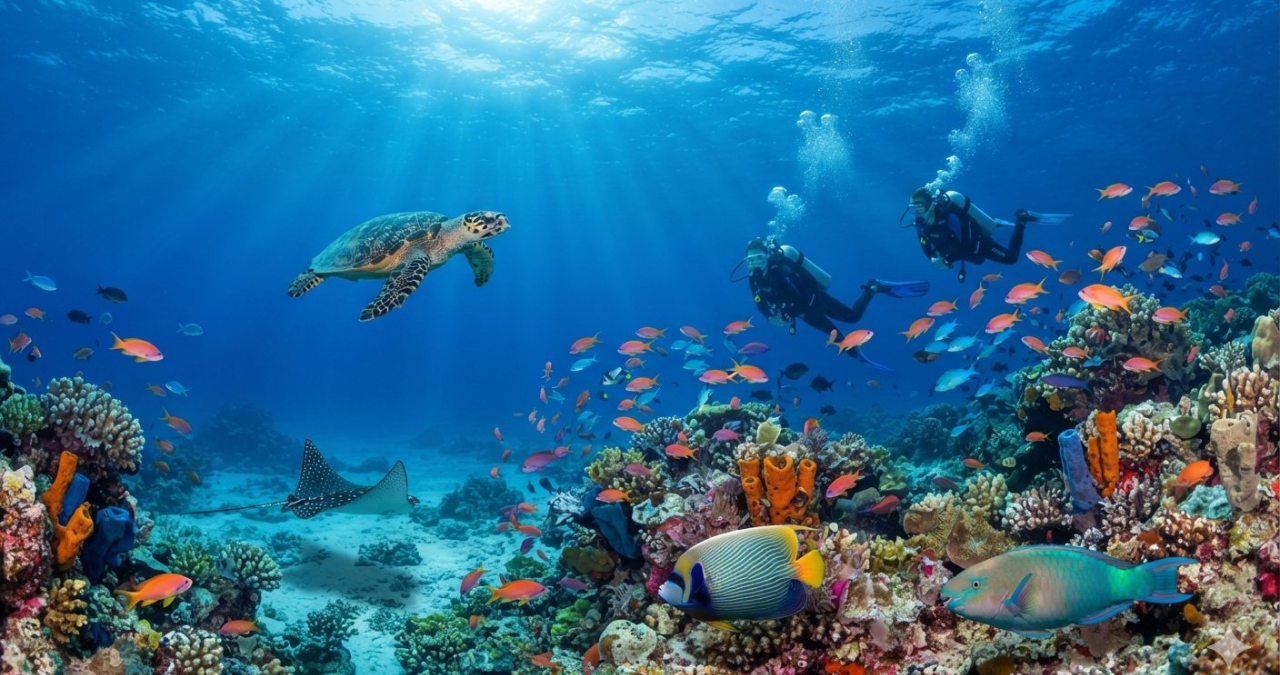
The ocean is one of Earth’s greatest natural treasures. It stretches across huge areas of our planet and supports an incredible variety of life. From tiny organisms floating near the surface to giant whales swimming through deep waters, marine life has adapted to many different conditions.
For humans, the sea is much more than a beautiful place to visit. It helps control Earth’s climate, supports food supplies, provides jobs, connects countries through shipping, and offers valuable resources for scientific research. It also plays a major role in the water cycle and the movement of heat around the planet.
Even though scientists have learned a great deal about marine environments, much remains unknown. Deep underwater areas are difficult to explore because of darkness, cold temperatures, and intense pressure. As technology improves, researchers continue to discover fascinating species and underwater landscapes.
Understanding this natural world is important because its health affects the health of our entire planet.
What Is the Ocean?
The ocean is a huge connected body of salty water that covers most of Earth’s surface. Although people commonly divide it into the Pacific, Atlantic, Indian, Southern, and Arctic regions, these waters are connected as part of one global system.
Seawater contains dissolved salts and minerals. Its exact salt content can differ from one location to another because of rainfall, evaporation, melting ice, and freshwater flowing from rivers.
Waves, tides, and currents keep seawater moving. These movements are influenced by wind, gravity, Earth’s rotation, temperature differences, and changes in water density. Together, they create a constantly changing environment.
The size and complexity of the seas make them important subjects for geography, biology, chemistry, geology, and climate science.
Why the Ocean Matters to Earth
The ocean has a major influence on Earth’s natural systems. Water can absorb and store large amounts of heat, which helps reduce sudden temperature changes across the planet.
Warm water can move toward colder regions through currents, while colder water travels toward warmer areas. This enormous circulation system helps distribute heat around the world.
The sea also forms a central part of the water cycle. Water evaporates from the surface, rises into the atmosphere, forms clouds, and later returns as rain or snow. Some of this water eventually flows back toward the sea through rivers and groundwater.
Marine environments also absorb carbon dioxide from the atmosphere. This natural process is important for Earth’s carbon cycle, although increasing carbon dioxide levels are changing seawater chemistry and creating additional environmental challenges.
Different Zones Beneath the Surface
The ocean changes dramatically as depth increases. Sunlight becomes weaker, temperatures often fall, and pressure becomes much stronger.
Near the surface, sunlight allows phytoplankton and other organisms to carry out photosynthesis. These tiny life forms are extremely important because they provide food for many marine animals and support large food webs.
Farther below, very little light is available. This region is sometimes called the twilight zone. Many animals living there have special adaptations that help them find food and avoid predators.
In the deepest areas, there may be complete darkness. Yet life still exists there. Some creatures produce their own light through bioluminescence, while others survive by feeding on material that slowly sinks from upper waters.
A Simple Look at Marine Zones
| Marine area | Main condition | Examples of life |
|---|---|---|
| Surface waters | Plenty of sunlight | Plankton, fish, turtles |
| Twilight region | Very little light | Squid, jellyfish, fish |
| Deep waters | Dark and cold | Deep-sea fish, worms |
| Seafloor | High pressure | Crustaceans, microbes |
These zones show that marine life can survive under conditions that would be difficult for humans.
Amazing Animals Found in the Ocean
The ocean is home to an extraordinary collection of animals. Some are familiar, while others look almost unbelievable.
Whales and dolphins are among the best-known marine mammals. They breathe air but spend most of their lives in water. Sharks, meanwhile, are important predators that help maintain balance within many marine ecosystems.
Sea turtles travel long distances between feeding and nesting areas. Octopuses are known for their intelligence, flexible bodies, and ability to change color and texture. Jellyfish have existed for hundreds of millions of years and can be found in many different marine environments.
Other animals include:
- Seahorses
- Rays
- Seals
- Penguins
- Crabs
- Lobsters
- Sea stars
- Squid
- Eels
- Marine snails
Every species has a role. Some are predators, some eat plants or plankton, and others recycle nutrients. Losing one species can sometimes affect many others because ecosystems are closely connected.
Coral Reefs and Coastal Habitats
The ocean contains many special habitats, and coral reefs are among the most famous. Coral reefs are built by tiny animals called coral polyps. Over long periods, their hard structures create homes for many other organisms.
Reefs can support fish, sea turtles, mollusks, crustaceans, and countless small creatures. Their colorful appearance also makes them important for tourism and education.
Other valuable habitats include mangrove forests, salt marshes, seagrass meadows, rocky shores, and sandy beaches.
Mangroves are especially useful along tropical and subtropical coastlines. Their roots provide shelter for young marine animals and can help reduce the force of waves and storms.
Seagrass meadows are also important. They provide feeding and nursery areas for marine species while storing carbon in their plants and surrounding sediments.
Protecting these habitats helps both wildlife and coastal communities.
How the Ocean Supports Human Life
The ocean provides food, transportation, employment, recreation, and economic opportunities for millions of people.
Fishing is an important source of food and income in many countries. When fishing is carefully managed, marine resources can support communities for generations.
Shipping is another major part of the global economy. Large vessels carry goods between ports, helping countries trade products and materials.
Coastal areas also support tourism. People travel to beaches, islands, reefs, and seaside towns for swimming, boating, diving, fishing, and sightseeing.
Marine environments can also provide opportunities for scientific discovery and renewable energy development. However, resources should be used responsibly so that natural ecosystems aren’t damaged.
Ocean Currents and Weather
The ocean works like a giant system for moving heat around Earth. Currents transport warm and cold water across great distances, affecting temperatures and weather conditions.
Surface currents are often strongly influenced by wind. Deep currents can be driven by differences in temperature and salt content. Because colder and saltier water is generally denser, it can sink and contribute to large-scale circulation.
These movements influence marine ecosystems because currents transport nutrients and plankton. They also affect where certain fish and other animals can find suitable food.
Scientists study currents to better understand climate patterns, weather systems, and changes in marine habitats. The information is useful for researchers, sailors, fishermen, and coastal communities.
Exploring the Deep Ocean
The ocean remains one of the least explored environments on Earth. Reaching great depths is difficult because water pressure increases enormously below the surface.
Researchers use specialized equipment such as remotely operated vehicles, autonomous underwater vehicles, sonar systems, cameras, sensors, and research vessels.
These tools allow scientists to observe underwater mountains, deep trenches, volcanic areas, canyons, and unusual ecosystems.
Hydrothermal vents are especially fascinating. They occur where hot, mineral-rich water rises from cracks in the seafloor. Communities of organisms can live around these vents even without sunlight.
Instead of depending directly on sunlight, some microorganisms use chemical energy to produce food. This process supports food webs in places that once seemed too extreme for life.
Such discoveries remind us that Earth still contains many mysteries.
Problems Affecting Marine Environments
The ocean is powerful, but it isn’t invincible. Human activities have created several environmental pressures.
Plastic pollution is one major concern. Waste can reach waterways and eventually enter marine habitats. Large plastic objects can injure animals, while tiny particles called microplastics can spread through the environment.
Overfishing is another challenge. Removing too many fish can reduce populations and disturb food webs. Responsible fishing rules can help keep marine resources available while protecting ecosystems.
Climate change is also affecting marine environments. Warmer water can place stress on coral reefs and other organisms. Changes in chemistry caused by increasing carbon dioxide can make it harder for some marine organisms to build shells or skeletons.
Coastal development, pollution, and habitat destruction can add further pressure.
The good news is that many of these problems can be reduced through careful planning and responsible action.
Simple Ways to Protect Marine Life
Protecting the ocean doesn’t always require dramatic actions. Everyday choices can make a difference when millions of people take part.
People can help by:
- Using fewer disposable plastic products
- Putting waste in the correct bins
- Avoiding litter near rivers and beaches
- Reusing useful items instead of throwing them away
- Supporting responsible fishing practices
- Conserving electricity and water
- Learning about marine ecosystems
- Respecting wildlife during coastal visits
- Supporting habitat restoration
- Reducing activities that contribute to climate change
Schools can also play an important role. Students can learn about marine animals, recycling, climate science, and conservation through projects and classroom activities.
Small habits may seem simple, but they can create meaningful results when communities work together.
The Importance of Marine Research
The ocean is studied by scientists from many different fields. Marine biologists examine animals and plants, while oceanographers study currents, waves, temperatures, and other physical processes.
Geologists explore the seafloor and underwater volcanic activity. Chemists study seawater and changes in its composition. Climate scientists examine how marine systems interact with the atmosphere.
Modern technology has made research much easier. Satellites can observe large areas from space, while underwater robots can travel into places that are too deep or dangerous for people.
Scientists also use long-term measurements to identify changes over time. This information can help governments and communities make better decisions about fishing, conservation, coastal development, and climate adaptation.
There is still plenty to discover, which makes marine science an exciting field for future researchers.
Ocean Safety for Visitors
The ocean can be enjoyable, but visitors should always remember that natural conditions can change quickly.
Waves, tides, currents, weather, and water temperatures can create risks. A beach that looks calm may still have strong currents farther from shore.
People should follow local safety signs and warnings. Swimming in supervised areas is generally safer than entering unfamiliar waters alone.
Important safety habits include:
- Check local weather and water conditions.
- Follow lifeguard instructions.
- Watch children carefully around water.
- Don’t ignore warnings about strong currents.
- Avoid approaching wild marine animals.
- Use suitable safety equipment when boating.
- Take litter with you when leaving the beach.
Being careful doesn’t reduce the fun. Instead, it helps people enjoy coastal environments with greater confidence and respect.
What the Future May Hold
The ocean faces important challenges, but there are strong reasons to remain hopeful. Around the world, researchers, communities, schools, conservation groups, and governments are working to improve marine protection.
Restoration projects are helping damaged habitats recover. Marine protected areas can give important ecosystems greater protection when they are properly designed and managed.
Better technology is also helping scientists monitor water quality, animal populations, temperatures, and habitat changes.
Young people have an especially important role in the future. Today’s students may become tomorrow’s marine scientists, engineers, conservationists, teachers, or environmental leaders.
Progress won’t happen overnight, but consistent action can lead to meaningful improvement. Protecting nature is a long-term effort, and every responsible choice matters.
Fascinating Facts About the Ocean
The ocean is full of surprising facts that show how extraordinary our planet is.
- It covers most of Earth’s surface.
- Its deepest areas are thousands of meters below sea level.
- Sound travels efficiently through seawater.
- Some marine animals produce their own light.
- Phytoplankton form the base of many marine food webs.
- Coral reefs are created by tiny living animals.
- Some sea animals travel thousands of kilometers during migrations.
- Deep-sea communities can survive without sunlight.
- Underwater mountains and volcanoes form part of the seafloor.
- Scientists continue to discover new marine species.
These facts only scratch the surface. The more researchers learn, the more interesting marine environments become.
Why Protecting Our Blue Planet Matters
The ocean connects people and nature in ways that aren’t always easy to see. A healthy marine environment can support wildlife, coastal communities, food systems, and climate processes.
Protecting it isn’t only about saving beautiful beaches or famous animals. It’s also about maintaining the natural systems that make life on Earth possible.
Governments can create strong environmental policies, businesses can reduce harmful waste, scientists can develop better solutions, and individuals can make responsible daily choices.
Working together is the key. No single action will solve every environmental problem, but thousands of sensible actions can create lasting change.
The future can be brighter when people treat natural resources with care and understand the value of long-term conservation.
Conclusion
The ocean is one of Earth’s most valuable and fascinating natural systems. It supports an enormous variety of life, influences climate, moves heat around the planet, contributes to the water cycle, and provides important benefits to human communities.
At the same time, pollution, overfishing, habitat destruction, and climate change are placing pressure on marine environments. These challenges shouldn’t be ignored, but they also don’t mean that the future is hopeless.
Through education, scientific research, responsible resource use, conservation, and everyday environmental choices, people can help create healthier marine ecosystems.
There is still so much to learn about the world beneath the waves. With curiosity, cooperation, and careful action, future generations can continue exploring its mysteries while protecting the natural systems that support us all. A healthier planet begins with understanding and respecting the ocean.
Stay in touch to get more updates & news on Us Daily Hub!