
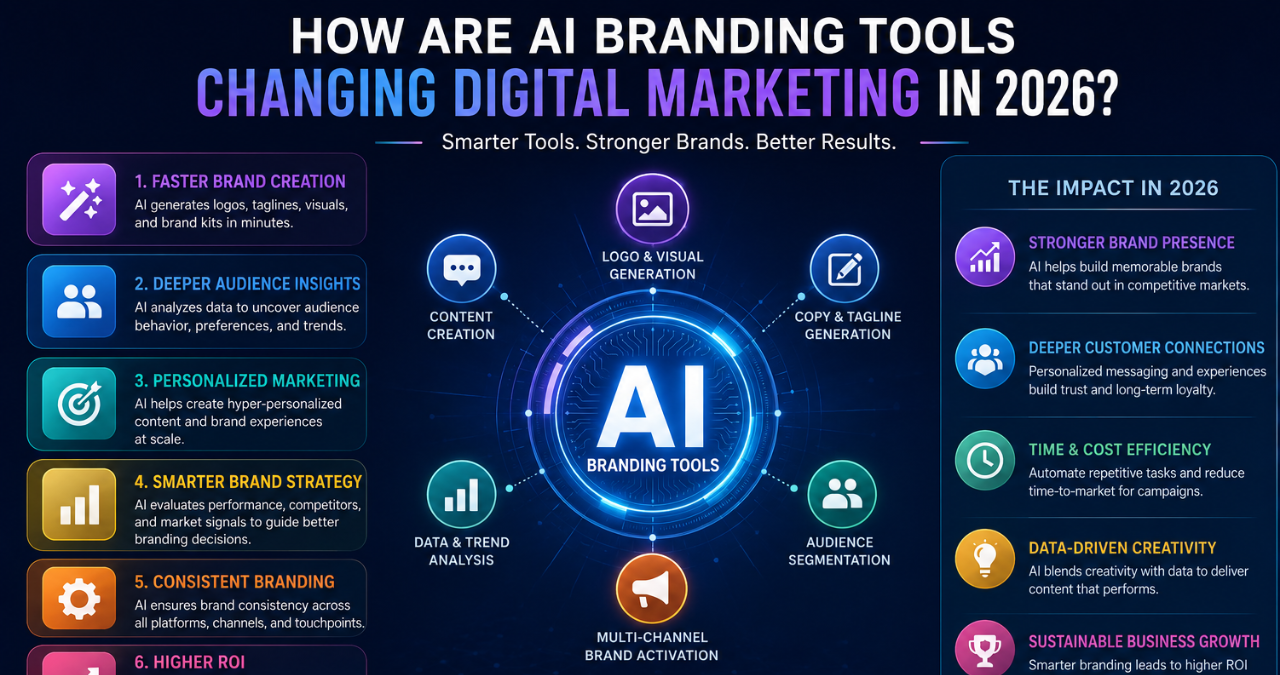
Explore how AI branding tools are reshaping digital marketing in 2026 through automation, personalization, smarter design, and faster brand growth.
Digital marketing in 2026 looks very different from what brands experienced just a few years ago. Businesses now rely on artificial intelligence to build visual identities, personalize campaigns, analyze customer behavior, and improve content performance across multiple platforms. What once required large creative teams and long production cycles can now happen in minutes with AI-powered tools.
At the center of this shift are AI branding platforms that help businesses create logos, social assets, messaging, and brand guidelines with greater speed and accuracy. Startups, ecommerce stores, local businesses, and creators are increasingly using tools like an AI logo generator to build professional branding without high design costs. As competition grows online, companies are turning to AI to improve consistency, increase engagement, and adapt quickly to changing consumer expectations.
The rise of AI branding tools is not replacing marketers. Instead, it is helping them work smarter, make data-driven decisions, and focus on creativity and strategy.
What Are AI Branding Tools and Why Are They Growing in 2026?
AI branding tools are software platforms that use machine learning, automation, and data analysis to help businesses create and manage brand identities. These tools can generate logos, suggest brand colors, create ad copy, produce social media graphics, and even recommend campaign strategies based on audience behavior.
In 2026, these platforms have become more advanced because AI models can now analyze trends, customer preferences, and competitor performance in real time. Businesses no longer need to guess what style or message will connect with audiences. AI systems can identify patterns and suggest branding decisions that match market demand.
Small businesses especially benefit from this shift. Traditional branding often required agencies, designers, copywriters, and long approval processes. AI tools reduce these barriers by making professional branding accessible to businesses with limited budgets.
According to a report from McKinsey & Company, companies using AI in marketing and sales continue to see measurable improvements in customer acquisition and operational efficiency. Similarly, Adobe’s 2026 Digital Trends report highlights growing adoption of AI-powered creative workflows among brands worldwide.
Key Takeaway
AI branding tools simplify branding tasks, reduce costs, and help businesses respond faster to market trends in 2026.
How Is AI Improving Brand Identity Creation?
Creating a recognizable brand identity used to take weeks or months. In 2026, AI tools can generate brand assets within minutes while still allowing room for customization and creative control.
AI branding systems analyze industry trends, color psychology, typography preferences, and audience behavior before suggesting visual identities. A restaurant brand, for example, may receive warm color palettes and modern typography, while a cybersecurity company may receive sharper designs with trust-focused branding.
These tools also improve consistency across channels. Once a logo and brand style are created, AI platforms can automatically apply them to:
- Social media graphics
- Email campaigns
- Website banners
- Product packaging
- Video thumbnails
- Digital advertisements
This level of consistency is important because consumers interact with brands across multiple touchpoints every day. Consistent branding helps improve recognition and trust.
AI also supports faster experimentation. Marketers can test several logo styles, visual themes, or messaging angles without restarting projects from scratch. This flexibility helps businesses adapt quickly when trends change.
Brands featured in technology and business coverage on USDailyHub’s digital marketing section often highlight speed and adaptability as essential factors for online growth. AI branding aligns directly with these priorities.
Key Takeaway
AI helps businesses create faster, more consistent, and more adaptable brand identities across digital channels.
Why Are Personalized Marketing Campaigns Becoming More Effective?
One of the biggest advantages of AI branding tools in 2026 is personalized marketing. Consumers now expect brands to deliver relevant experiences instead of generic advertising.
AI systems analyze customer data such as:
- Purchase history
- Browsing behavior
- Social engagement
- Geographic trends
- Search intent
- Device usage
Based on this information, AI can generate customized messaging, product recommendations, and visuals for different audience groups.
For example, an online clothing retailer may show one ad version to college students and another to working professionals. Even though both campaigns promote the same product, the tone, design, and messaging can differ significantly.
This personalization improves click-through rates, engagement, and customer retention.
What Is Predictive Personalization?
Predictive personalization uses AI to anticipate what customers may want before they actively search for it.
Instead of reacting to behavior, AI predicts future interests using historical data patterns. Streaming platforms, ecommerce websites, and subscription brands increasingly rely on predictive personalization to improve customer experiences.
A 2026 Salesforce study found that consumers are more likely to engage with brands that provide personalized recommendations and tailored communication.
Key Takeaway
AI branding tools improve personalization by helping businesses deliver more relevant content, visuals, and customer experiences.
How Are AI Branding Tools Changing Social Media Marketing?
Social media marketing moves extremely fast in 2026. Trends can rise and disappear within days. AI branding tools help marketers keep pace without sacrificing quality.
Modern AI platforms can now:
- Generate social captions
- Suggest hashtags
- Design platform-specific graphics
- Create short-form videos
- Schedule content automatically
- Analyze engagement patterns
These tools also identify the best posting times based on audience behavior. Instead of relying on manual trial and error, marketers can optimize campaigns using real-time data.
AI-generated visual content has become especially important for short-form platforms like TikTok, Instagram Reels, and YouTube Shorts. Brands that consistently produce engaging visuals are more likely to maintain visibility.
Another major change is sentiment analysis. AI systems can track how users respond emotionally to campaigns, products, or announcements. If negative reactions increase, brands can quickly adjust messaging before reputation issues grow.
Key Takeaway
AI branding tools help businesses create faster social content, improve engagement, and respond quickly to audience behavior.
Are AI Branding Tools Replacing Human Creativity?
A common concern is whether AI will replace designers, marketers, and creative professionals. In reality, most businesses in 2026 use AI to support human creativity rather than eliminate it.
AI excels at automation, data analysis, and repetitive production tasks. However, human marketers still play a critical role in:
- Brand storytelling
- Emotional connection
- Strategic direction
- Cultural understanding
- Ethical decision-making
- Creative originality
For example, AI can generate multiple ad variations quickly, but marketers decide which version aligns best with brand values and customer expectations.
Human oversight also matters because AI systems can sometimes produce repetitive or generic outputs. Strong brands still need originality, emotional depth, and authentic communication.
The most successful marketing teams now combine AI efficiency with human creativity. This hybrid approach allows companies to scale content production while maintaining a unique brand voice.
Key Takeaway
AI is changing creative workflows, but human strategy and storytelling remain essential for strong branding.
What Challenges Do Businesses Face With AI Branding?
Although AI branding tools offer many benefits, businesses still face several important challenges.
Data Privacy Concerns
AI systems rely heavily on customer data. Businesses must follow privacy regulations and ensure they collect data responsibly.
Consumers are increasingly aware of how companies use their information. Brands that misuse data may lose trust quickly.
Brand Originality Issues
Some AI-generated branding can feel repetitive because many businesses use similar tools and templates. Companies must customize outputs carefully to avoid looking generic.
Overdependence on Automation
Relying too heavily on automation may reduce emotional connection with audiences. Customers still value authentic communication and human interaction.
Ethical Concerns
AI-generated content can sometimes create misinformation, bias, or misleading visuals if not monitored properly. Businesses need clear review processes before publishing campaigns.
Skills Gap
Many companies still struggle to train teams on how to use AI tools effectively. Successful implementation requires both technical understanding and marketing expertise.
Key Takeaway
Businesses using AI branding tools must balance automation with originality, privacy protection, and human oversight.
How Can Businesses Use AI Branding Tools Effectively in 2026?
Companies that succeed with AI branding usually follow a strategic approach instead of relying on automation alone.
1. Define Clear Brand Guidelines
Businesses should establish clear tone, style, messaging, and design standards before using AI tools. This helps maintain consistency.
2. Use AI for Speed, Not Final Judgment
AI works best for generating ideas, drafts, and variations. Human teams should still review and refine content.
3. Combine AI With Customer Feedback
Brands should monitor audience reactions and adjust campaigns regularly. AI insights become more valuable when combined with real customer input.
4. Focus on Personalization
Customized experiences improve engagement and customer loyalty. Businesses should use AI data carefully to create more relevant communication.
5. Monitor Performance Metrics
Marketers should track metrics like:
- Engagement rate
- Conversion rate
- Click-through rate
- Customer retention
- Brand sentiment
Performance analysis helps businesses understand which AI-driven strategies produce the best results.
Key Takeaway
The most effective AI branding strategies combine automation, human review, customer feedback, and performance tracking.
What Does the Future of AI Branding Look Like?
AI branding tools will likely become even more advanced over the next few years. Experts expect future platforms to provide deeper audience prediction, real-time campaign adaptation, and stronger cross-platform automation.
Voice branding may also grow significantly. AI systems can already generate branded voice assistants, podcast scripts, and audio advertisements tailored to different audiences.
Another emerging trend is AI-powered immersive branding for augmented reality and virtual shopping experiences. As digital environments become more interactive, brands will need dynamic identities that adapt across multiple digital spaces.
At the same time, consumer expectations around authenticity and transparency will continue to grow. Businesses that use AI responsibly while maintaining human-centered communication will likely build stronger long-term trust.
Key Takeaway
The future of AI branding will focus on smarter personalization, immersive experiences, and responsible human-centered marketing.
Frequently Asked Questions
How do AI branding tools help small businesses?
AI branding tools reduce design costs, automate repetitive tasks, and help small businesses create professional marketing materials quickly.
Quick Summary: AI tools make branding more affordable and accessible for smaller businesses.
Can AI create a complete brand identity?
Yes, many AI tools can generate logos, color palettes, fonts, messaging suggestions, and social media templates. However, human input is still important for originality and strategy.
Quick Summary: AI can build core brand assets, but human creativity improves uniqueness and direction.
Are AI branding tools expensive in 2026?
Many AI branding platforms offer affordable subscription plans compared to traditional agency services. Pricing varies based on features and usage.
Quick Summary: AI branding tools are usually more cost-effective than traditional branding agencies.
Do AI branding tools improve SEO performance?
AI tools can support SEO by generating optimized content ideas, improving consistency, and analyzing audience behavior. However, quality content and strategy still matter most.
Quick Summary: AI supports SEO efforts by improving efficiency and content optimization.
Is AI branding safe for customer data?
AI branding can be safe when businesses follow privacy regulations and use secure platforms. Responsible data handling is essential.
Quick Summary: Safe AI branding depends on proper data privacy practices and transparent policies.
Conclusion
AI branding tools are transforming digital marketing in 2026 by making branding faster, smarter, and more personalized. Businesses now use AI to create visual identities, improve customer engagement, automate campaigns, and analyze performance with greater accuracy.
At the same time, successful branding still depends on human creativity, ethical decision-making, and authentic storytelling. Companies that combine AI efficiency with strong brand strategy are more likely to stand out in crowded digital markets.
As technology continues to evolve, AI branding will become an even larger part of how businesses communicate online. Brands that adapt thoughtfully will be better positioned to build trust, improve visibility, and compete in the rapidly changing digital economy.
Final Summary: AI branding tools are reshaping digital marketing through automation, personalization, and smarter content creation while human creativity remains essential for lasting brand success.
Stay in touch to get more updates & news on Us Daily Hub!