
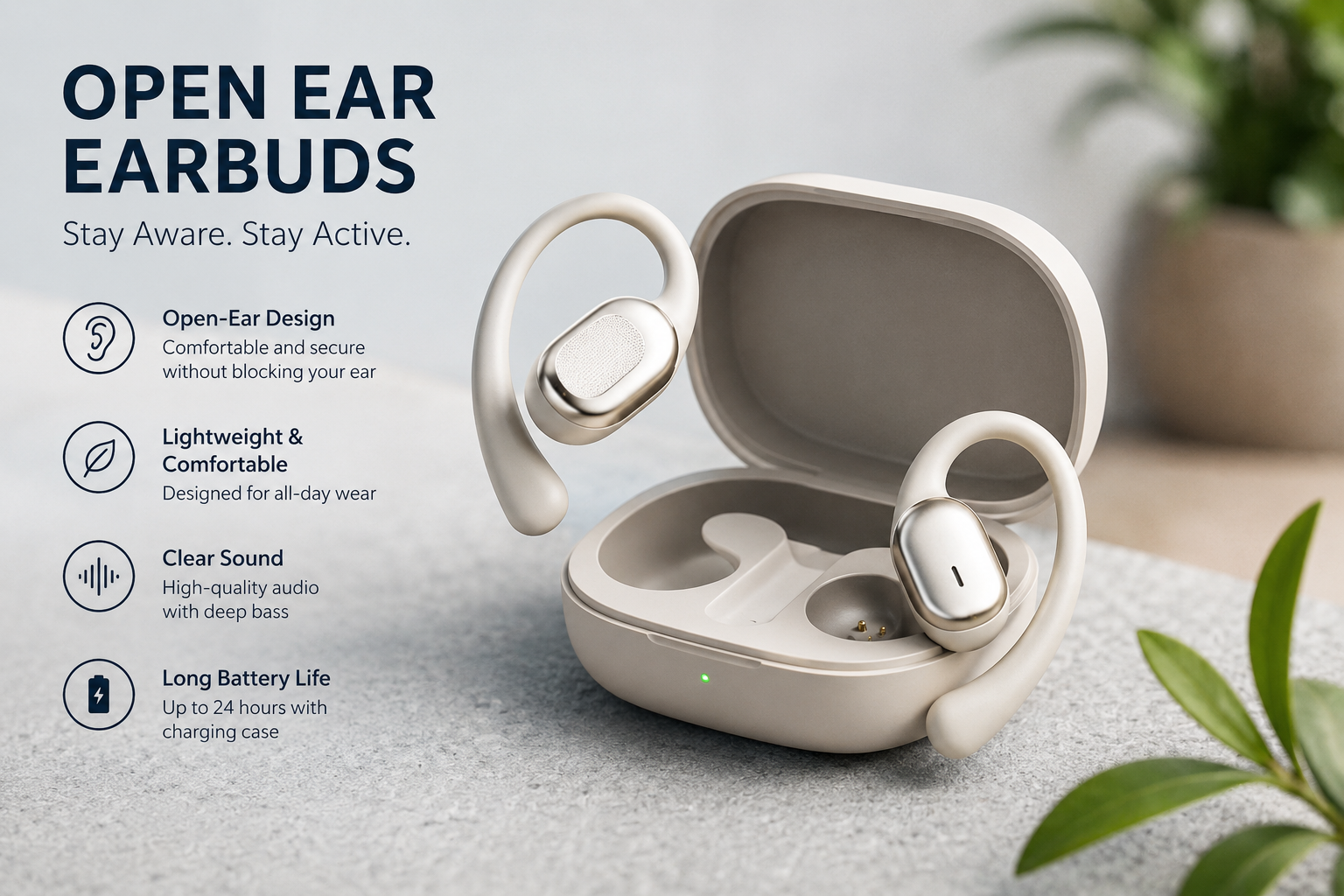
If you’re looking for a way to enjoy music, podcasts, calls, and videos without completely blocking the world around you, open ear earbuds are worth knowing about. Unlike traditional in-ear headphones that sit inside the ear canal, open ear earbuds are designed to let your ears remain open while delivering sound in a more natural and comfortable way.
This design has become increasingly popular among people who want audio while staying aware of conversations, traffic, coworkers, family members, or other sounds around them. Whether you’re exercising, working, walking, traveling, or simply relaxing at home, the right pair can offer a useful balance between entertainment and environmental awareness.
This guide explains how open ear earbuds work, their main benefits and drawbacks, important features to consider, how they compare with traditional earbuds, and how to choose a pair that fits your lifestyle.
What Are open ear earbuds?
open ear earbuds are wireless listening devices designed to deliver sound without completely covering or sealing the ear canal. Instead of pushing a traditional ear tip deep into your ear, many open-ear designs position a small speaker near the ear while leaving the ear canal open.
This approach gives users a different listening experience. You can hear your audio while still hearing sounds from your surroundings. For example, you might listen to music during a walk and still notice a bicycle bell, a nearby vehicle, or someone speaking to you.
There are several technologies used in open-ear products. Some models use directional speakers, while others use bone or air conduction principles. Although the technology differs between products, the general goal is similar: provide useful audio without fully closing the ear canal.
How open ear earbuds Work
The basic idea behind open ear earbuds is surprisingly simple. Instead of creating a tight seal inside your ear, the speaker is positioned close to the ear and sends sound toward your hearing system.
Traditional in-ear earbuds usually depend on an ear tip that fits inside the ear canal. That seal can improve bass response and help block outside noise. Open-ear products take the opposite approach.
Depending on the design, sound may be directed toward the outer ear or transmitted through nearby structures. Some products use a small speaker that sits just outside the ear canal. Others use bone conduction, where vibrations travel through parts of the skull toward the inner ear.
This means different open-ear products shouldn’t be treated as identical. Their sound quality, bass performance, volume, comfort, and environmental awareness can vary considerably.
Why People Choose open ear earbuds
One of the biggest attractions of open ear earbuds is awareness. Many listeners don’t want to feel disconnected from everything happening around them.
Imagine working in an office while listening to a podcast. With sealed earbuds, you might miss a coworker’s question. With an open design, you may be able to hear both the podcast and the person speaking nearby.
They’re also useful in situations where complete isolation isn’t desirable.
Common reasons people choose them include:
- Staying aware while walking
- Listening during outdoor exercise
- Taking calls while remaining aware of surroundings
- Working in shared spaces
- Enjoying podcasts while doing household tasks
- Avoiding the plugged-ear feeling of traditional earbuds
- Reducing pressure caused by some in-ear designs
- Listening for longer periods with a more open sensation
Of course, awareness doesn’t automatically make any activity completely safe. When you’re near roads or other hazards, your attention should remain focused on your surroundings.
Main Benefits of open ear earbuds
The growing popularity of open ear earbuds comes from several practical advantages. They’re not necessarily better than traditional earbuds for everyone, but they can be a great alternative for specific situations.
Environmental awareness
This is arguably the biggest advantage. Since the ear canal isn’t completely sealed, outside sounds can remain audible.
That can be helpful when walking outdoors, exercising in public areas, or working around other people.
Comfortable listening
Some people dislike the sensation of having silicone tips pressed inside their ears. Open-ear designs avoid that particular feeling.
Comfort still depends on the shape and weight of the product, but many users appreciate the lighter, less enclosed sensation.
Useful for conversations
You don’t always need to remove your earbuds when someone talks to you. With a suitable open design, you may be able to continue listening while also hearing the person nearby.
That’s particularly convenient at work or at home.
Good for outdoor activities
Runners, walkers, cyclists, and outdoor enthusiasts may appreciate the ability to hear their environment.
However, audio devices should never replace proper safety habits. Keep volume at a sensible level and remain alert.
Less isolation
Traditional noise-isolating earbuds can create a very private listening bubble. That’s useful in some environments, but not always desirable.
Open designs provide a more connected listening experience.
Potential Drawbacks of open ear earbuds
No audio design is perfect. Before buying open ear earbuds, it’s important to understand their limitations.
Less noise isolation
The feature that makes open earbuds attractive can also be their weakness. Because your ears remain open, environmental sounds can compete with your music.
A busy street, airplane cabin, construction site, or crowded train may make listening difficult.
Bass can feel different
Sealed earbuds often create strong bass because they form an acoustic seal. Open-ear designs generally don’t provide the same type of isolation.
Some modern models have improved bass significantly, but listeners who love powerful low-end sound may still prefer traditional in-ear earbuds.
Sound leakage
Depending on the design and volume, people nearby may hear some of your audio.
This isn’t always a problem, but it can matter in quiet offices, libraries, classrooms, or other shared spaces.
Fit varies between users
Ear shapes are different. A design that feels secure for one person may feel loose or uncomfortable for another.
That’s why fit should be considered just as carefully as sound quality.
open ear earbuds vs Traditional Earbuds
Understanding the difference can make your buying decision much easier.
| Feature | open ear earbuds | Traditional in-ear earbuds |
|---|---|---|
| Ear canal | Usually remains open | Usually covered or sealed |
| Environmental awareness | High | Low to moderate |
| Noise isolation | Limited | Usually stronger |
| Bass potential | Good to moderate depending on design | Often strong |
| Plugged-ear feeling | Usually lower | More common |
| Outdoor awareness | Strong advantage | More limited |
| Sound leakage | Can occur | Usually lower |
| Workout use | Often convenient | Depends on fit |
| Private listening | Less ideal | Usually better |
| Long listening comfort | Highly dependent on design | Highly dependent on design |
Neither category wins in every situation. The best option depends on how and where you listen.
Different Types of open ear earbuds
The term open ear earbuds can describe several different approaches.
Open-air speaker designs
These products use small speakers positioned near the ear without entering the ear canal.
They can provide a relatively natural listening experience while keeping the ears open.
Bone conduction designs
Bone conduction headphones use vibrations that travel through the bones around the ear toward the inner ear.
They don’t rely on sending sound directly through the ear canal in the same way as ordinary speakers.
Air conduction open-ear designs
These products use speakers that send sound through the air toward the ear. The speaker generally sits near the ear rather than inside the canal.
This category has become popular because it can combine an open feeling with relatively detailed audio.
Important Features to Check Before Buying
When comparing open ear earbuds, don’t focus only on the brand name or appearance. A few technical and practical features deserve attention.
Comfort and fit
Comfort should be near the top of your list.
Look for:
- Lightweight construction
- A secure but gentle fit
- Soft contact points
- Flexible ear hooks when appropriate
- Minimal pressure
- A shape suitable for your ear
If possible, try the product before committing to extended use.
Sound quality
Listen for clear vocals, balanced instruments, and enough bass for your preferences.
Keep in mind that open-ear audio won’t necessarily sound exactly like sealed in-ear headphones. That’s part of the design.
Battery life
Battery performance matters if you plan to use your earbuds throughout the day.
Consider both the earbuds’ playback time and the additional power supplied by the charging case, if one is included.
Water and sweat resistance
If you plan to exercise with your earbuds, check their water and sweat resistance rating.
Don’t assume that every product is suitable for heavy rain or swimming. Water resistance levels have different meanings.
Microphone quality
For frequent calls, microphone performance can be just as important as speaker quality.
Look for products designed to handle wind and background noise, especially if you’ll use them outdoors.
Bluetooth performance
A stable wireless connection is essential.
Check compatibility with your phone, tablet, computer, or other devices before purchasing.
Controls
Physical buttons and touch controls can both work well.
However, controls should be easy to use without accidental touches. This matters particularly during workouts.
How to Choose open ear earbuds for Exercise
For exercise, open ear earbuds can be a practical choice because they don’t completely isolate you from the surrounding environment.
During a walk or run, you may want to hear people, vehicles, signals, or other environmental sounds.
When selecting a pair for workouts, consider:
- Secure fit
- Lightweight construction
- Sweat resistance
- Stable Bluetooth connection
- Easy controls
- Reliable microphone
- Comfortable design for extended movement
For outdoor exercise, awareness is useful, but don’t rely entirely on your earbuds to protect you. Stay alert and follow local safety rules.
open ear earbuds for Work and Study
Open designs can also work well in professional and educational environments.
Suppose you’re listening to background music while working from home. You may still need to hear a family member, doorbell, phone notification, or colleague.
Similarly, an open-ear design can be useful for online meetings when you want to hear your surroundings at the same time.
However, they’re not always the best option for deep concentration in a noisy environment. If outside sounds constantly interrupt you, noise-isolating headphones may be more appropriate.
open ear earbuds for Calls
Phone calls are another area where open-ear products can be convenient.
Because your ears remain relatively open, you can often hear your own voice and surroundings more naturally than when both ears are heavily sealed.
Still, call quality depends heavily on the microphone system.
When evaluating a product for calls, consider:
- Voice clarity
- Wind reduction
- Background-noise handling
- Microphone placement
- Bluetooth stability
- Call controls
If you regularly take calls outside, microphone performance becomes especially important.
Are open ear earbuds Safe to Use?
open ear earbuds are designed differently from traditional sealed earbuds, but responsible listening habits are still important.
Keeping the volume at a reasonable level is essential. Excessively loud audio can contribute to hearing damage regardless of the headphone style.
A sensible approach is to avoid unnecessarily high volume and take breaks during long listening sessions.
Outdoor awareness is also important. Being able to hear your surroundings is helpful, but it doesn’t guarantee safety. A listener can still become distracted by music, podcasts, or phone calls.
When crossing roads, operating equipment, or participating in activities that require full attention, prioritize the activity over your audio.
How to Get Better Sound From open ear earbuds
Because open-ear products don’t seal the ear canal, positioning can make a meaningful difference.
Try adjusting the device so the speaker sits in the intended position relative to your ear. A small change can affect clarity and volume.
You can also improve the experience by:
- Choosing a quiet environment when possible
- Keeping the earbuds properly positioned
- Adjusting equalizer settings if supported
- Keeping the speaker openings clean
- Avoiding excessive volume
- Using high-quality audio sources
Don’t expect every open-ear model to deliver the same bass impact as a sealed earbud. Instead, judge whether the sound fits your needs.
How to Maintain Your Earbuds
Taking care of your open ear earbuds can help maintain their performance.
Clean them regularly using methods recommended by the manufacturer. Sweat, dust, skin oils, and debris can collect around speaker openings and contact points.
Also remember to:
- Store them in their case when possible
- Keep charging contacts clean
- Avoid unnecessary exposure to water
- Don’t use harsh cleaning chemicals
- Keep firmware updated when updates are provided
- Check the charging case periodically
- Avoid dropping or crushing the earbuds
Proper maintenance is simple, but it can make a noticeable difference over time.
Common Mistakes When Buying open ear earbuds
A common mistake is choosing a product based only on appearance.
A stylish design isn’t useful if it doesn’t stay securely in place.
Another mistake is expecting open-ear headphones to perform exactly like premium noise-isolating earbuds. Their goals are different.
Other mistakes include:
- Ignoring comfort
- Buying without checking device compatibility
- Forgetting about microphone quality
- Overlooking water resistance
- Expecting complete privacy
- Choosing based only on battery claims
- Using excessive volume
- Ignoring warranty and support
A good purchase starts with understanding your own listening habits.
Who Should Consider open ear earbuds?
open ear earbuds may be especially attractive to people who value environmental awareness and comfort.
They can be a strong option for:
- Outdoor walkers
- Runners
- People who dislike in-ear tips
- Office workers
- Remote workers
- Podcast listeners
- People who frequently switch between audio and conversation
- Users who want a less enclosed listening experience
They may be less suitable for someone who regularly travels in very noisy environments or wants strong passive noise isolation.
What to Consider Before Spending More
Higher prices don’t automatically mean a better listening experience.
Before paying extra, decide which features actually matter to you.
For example, if you mainly listen to podcasts during walks, you may prioritize comfort, speech clarity, battery life, and microphone quality.
If you’re an enthusiastic music listener, you may care more about frequency balance, bass response, codec support, and sound tuning.
A useful buying checklist includes:
| Priority | Question to Ask |
|---|---|
| Comfort | Can I wear them for a long session? |
| Fit | Will they stay secure while moving? |
| Sound | Is music and speech clear enough? |
| Awareness | Can I hear important environmental sounds? |
| Battery | Will the battery last through my normal day? |
| Durability | Can they handle my usual activities? |
| Calls | Is the microphone good enough for my needs? |
| Controls | Are playback and calls easy to manage? |
| Compatibility | Will they work properly with my devices? |
| Support | Does the manufacturer offer useful warranty service? |
The Future of open ear earbuds
The future looks promising for open ear earbuds because consumers are increasingly interested in flexible listening experiences.
Manufacturers continue to work on improving sound quality, battery efficiency, comfort, microphone performance, and wireless connectivity.
One important challenge is balancing environmental awareness with audio quality. Engineers want to create products that remain open while still producing clear vocals, enjoyable music, and satisfying low frequencies.
As technology develops, open-ear products may become more capable without losing the feature that makes them different in the first place.
Final Thoughts on open ear earbuds
open ear earbuds offer an interesting alternative to conventional in-ear headphones. Their biggest strength is the ability to enjoy audio while keeping your ears relatively open to the surrounding world.
They’re particularly appealing for outdoor activities, work environments, casual listening, and situations where you don’t want complete isolation. At the same time, they may not provide the powerful isolation or deep bass that some traditional earbuds deliver.
The smartest choice is to consider your personal priorities first. Think about comfort, sound quality, battery life, fit, microphone performance, durability, and where you’ll actually use them.
Ultimately, open ear earbuds aren’t about replacing every other type of headphone. They’re about giving listeners another practical option—one that combines personal audio with a greater sense of connection to the world around them.
Stay in touch to get more updates & news on Us Daily Hub!