
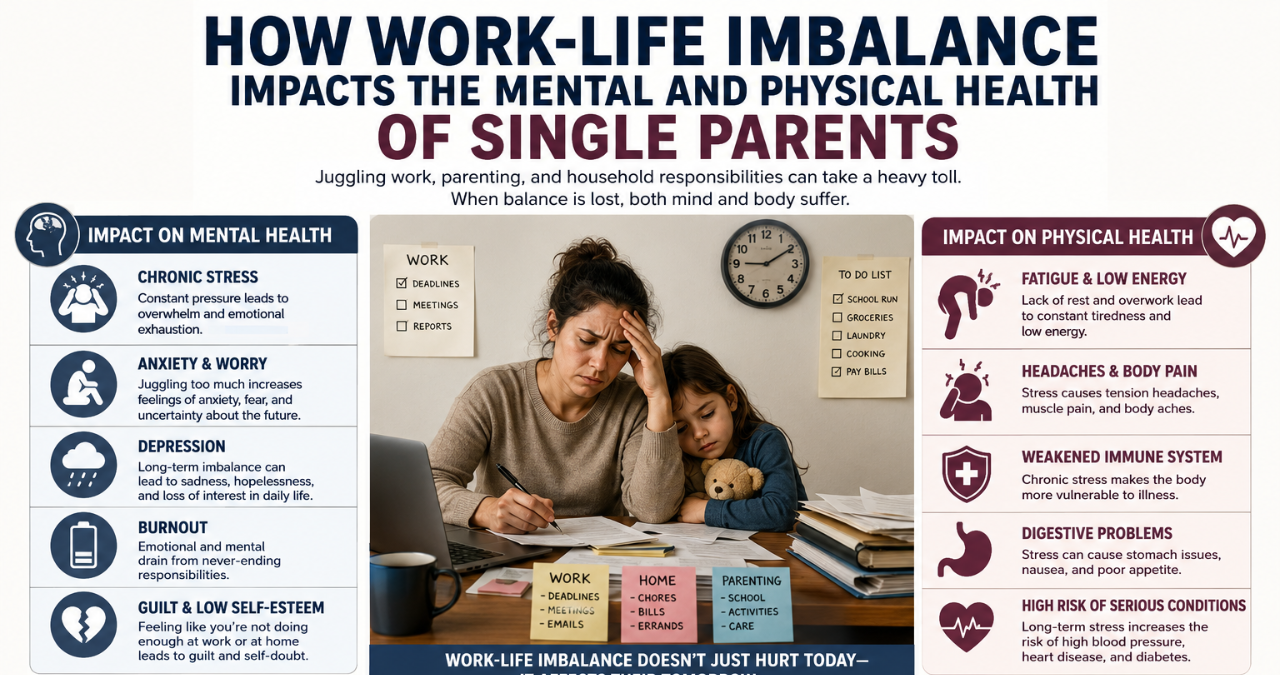
For many single parents, work-life balance sounds like something people talk about in offices, podcasts, or wellness articles, but not something that fits real life. Real life looks different. It looks like rushing from work to school pickup, checking messages while cooking dinner, folding laundry after bedtime, and wondering how one person is supposed to carry so many roles without falling apart.
A single parent’s day often starts before the sun has fully settled into the sky. There are lunches to pack, clothes to find, bills to think about, and children who need care, patience, and attention. Then work begins. Emails, shifts, deadlines, customers, meetings, reports, or long hours on your feet. By the time the paid work ends, the unpaid work is already waiting.
This is why work-life imbalance is not just a scheduling problem. It is a health problem. It can affect the mind, the body, relationships, and parenting confidence. It can make a parent feel like they are always behind, even when they are doing everything they can.
And honestly, many single parents are doing more than enough. The problem is not a lack of effort. The problem is that the load is too heavy for one person to carry alone every day.
The Daily Juggle That Never Really Ends
The daily routine of a single parent can feel like running a small company with no staff. There is planning, budgeting, transport, emotional care, cleaning, cooking, school communication, and work duties all happening at once. Even when the day looks normal from the outside, it can feel packed and noisy on the inside.
A parent may be sitting at work, but part of their mind is still at home. Did the child remember their homework? Is there enough food for dinner? Will the childcare payment clear? What happens if the boss asks for overtime? What if the school calls?
That kind of mental load does not clock out.
Single parents often move through the day with very little breathing room. A small delay can throw everything off. A late bus, a sick child, a meeting that runs over, or a bill that costs more than expected can turn an already full day into a stressful one.
When “balance” becomes another pressure
The phrase “work-life balance” can sound helpful, but for single parents, it can also feel like one more standard they are failing to meet. It suggests that work, parenting, home, and personal care can be neatly divided. In reality, they overlap constantly.
A parent may answer a work email while helping with homework. They may think about rent while reading a bedtime story. They may use their lunch break to call the doctor, pay a bill, or schedule a school meeting. This is not poor time management. This is survival.
The pressure to appear calm makes it harder. Many single parents feel they have to prove they can handle everything. They do not want to look unreliable at work. They do not want their children to see them stressed. They do not want friends or family to think they are struggling. So they keep going.
But keeping going without rest comes at a cost.
How Imbalance Hurts Mental Health
Work-life imbalance can slowly wear down mental health. It does not always arrive as a sudden crisis. Sometimes it shows up as irritability, forgetfulness, crying in private, or feeling emotionally flat. Sometimes it feels like waking up already tired, even after sleeping.
The mind needs space to reset. When a parent spends the whole day solving problems, planning ahead, and managing other people’s needs, the brain stays alert for too long. That constant alertness can lead to anxiety, stress, and burnout.
Here’s the thing. Burnout is not the same as ordinary tiredness. Tiredness improves with rest. Burnout feels deeper. It can make simple tasks feel heavy. It can make a parent feel distant from their own life. It can also create guilt, because many parents think they should be more patient, more organized, more cheerful, and more available.
That is a painful place to live.
Anxiety, burnout, and the fear of falling behind
For single parents, anxiety often comes from real pressure. It is not imagined. When one income supports the home, one missed shift can matter. When there is limited childcare, one schedule change can cause problems. When there is no steady backup, one emergency can feel huge.
This fear of falling behind can keep the body and mind in stress mode. A parent may overthink every choice. They may feel tense even during quiet moments. They may struggle to enjoy time with their child because another worry is always nearby.
Some parents try to cope in whatever way gives fast relief. For some, that means food, scrolling, shopping, alcohol, or substances. These habits often start as a way to calm down, sleep, or escape pressure for a little while. But when stress never stops, short-term relief can become a bigger problem.
Parents who reach that point need care, not judgment. Support, such as Washington drug and alcohol detox, can help when substance use becomes tied to stress, exhaustion, or daily survival.
Asking for help does not erase a parent’s love for their child. It protects it.
The Physical Toll Is Real Too
Stress does not stay in the mind. It moves into the body. A single parent living with constant imbalance may deal with headaches, back pain, stomach issues, muscle tension, high blood pressure, weight changes, or a weaker immune system. The body starts sending signals when it has been ignored for too long.
Sleep is often one of the first things to suffer. Some parents stay up late because nighttime is the only quiet time they have. Others want to sleep but cannot stop thinking. The house is finally quiet, yet the mind keeps working.
Poor sleep affects almost everything. It affects mood, appetite, focus, memory, and patience. It can make work harder and parenting harder. It can also make the body crave quick energy, such as sugar, caffeine, or fast food.
Food, movement, and the “I’ll deal with myself later” problem
Single parents often put their own health at the bottom of the list. The child’s appointment comes first. Work comes first. Bills come first. The broken sink, the school form, the grocery run, and the laundry all come first.
So the parent says, “I’ll deal with myself later.”
Later becomes next week. Then next month. Then it becomes normal to ignore pain, skip meals, miss checkups, and run on coffee.
A healthier life does not have to mean a perfect routine. Most single parents do not need another unrealistic wellness plan. They need small, possible steps. Drinking water before the second cup of coffee. Eating something with protein in the morning. Walking for ten minutes after work. Stretching while dinner cooks. Book the medical appointment instead of putting it off again.
Small care still counts. It may not look impressive, but it helps keep the body steady.
Parenting Confidence Can Take a Hit
Work-life imbalance can make even a loving parent question themselves. When you are always rushing, you may feel like you are not giving enough at work or at home. You may miss a school event. You may serve another quick dinner. You may lose patience over something small. Then guilt follows.
That guilt can be heavy.
Many single parents compare themselves to families with more help, more money, more flexible jobs, or another adult in the home. Social media can make this worse. Other people’s clean kitchens, packed lunches, family trips, and smiling photos can make a tired parent feel like they are falling short.
But parenting is not about creating a perfect image. It is about safety, love, structure, and repair. Children do not need perfect parents. They need parents who keep showing up, even after hard days.
Kids feel stress, but they also learn resilience
Children can sense stress in the home. They notice rushed mornings, tired voices, and quiet worry. But that does not mean every stressful season harms them forever.
Children also learn from how parents respond to hard moments. When a parent says, “I had a tough day, but I’m glad we’re together,” a child learns that feelings can be named. When a parent apologizes after snapping, a child learns repair. When a parent asks for help, a child learns that people do not have to struggle alone.
Of course, children should not carry adult problems. They should not become the parents’ counselor or emotional support system. But gentle honesty can create trust. It can help a child understand that stress is not their fault.
And sometimes, the small moments matter most. A bedtime hug. A shared snack. A five-minute conversation in the car. These moments may look ordinary, but they build connection.
When Stress Turns Into Isolation
One of the quietest effects of work-life imbalance is isolation. Single parents may stop seeing friends because they are tired, busy, or short on money. They may turn down invitations because childcare is too hard to arrange. Over time, people stop asking, and the parent becomes even more alone.
Isolation can make stress feel worse. Without adult support, every problem feels larger. There is no one to laugh with after a hard day, no one to help think through a decision, and no one to say, “You’re doing better than you think.”
That kind of support matters.
Single parents need community. It can come from family, friends, neighbors, school groups, online parent spaces, faith communities, or local support programs. It does not have to be a big circle. Even one reliable person can make life feel less heavy.
For parents dealing with substance use, isolation can be especially risky. Stress, loneliness, and exhaustion can feed unhealthy coping patterns. Recovery support, such as Illinois addiction treatment can help parents address substance use while also looking at mental health, family stress, and daily life pressures.
Support is not a luxury. For many parents, it is part of staying well.
What Realistic Relief Looks Like
Telling a single parent to relax is not enough. Telling them to “make time for self-care” can even sound insulting when their schedule is already full. Real relief has to fit real life.
That means looking at the pressure points. What part of the week causes the most stress? Is it morning chaos? Dinner? Homework? Work messages after hours? Childcare gaps? Money worries?
Once the biggest source of stress is clear, a parent can make one small change. Not ten changes. One.
Maybe school clothes are prepared at night. Maybe dinner is simple on workdays. Maybe a teacher gets told about the home situation so communication becomes easier. Maybe a manager is asked for a slightly clearer schedule. Maybe grocery pickup replaces a long store trip.
None of these fixes everything. But they reduce friction. And when life is already hard, less friction matters.
Tiny systems that protect your energy
Single parents do not need perfect systems. They need simple ones that remove repeated stress.
A calendar on the fridge can help. A basic meal routine can help. A backup childcare list can help. A Sunday reset can help. Even placing school bags by the door at night can make the morning less wild.
The point is not to become a productivity machine. The point is to save energy for the things that matter most.
Mental health support can also be part of realistic relief. Talking to a therapist gives parents a place to unpack stress without worrying about burdening their children. If substance use is involved, therapy for substance abuse can help parents understand triggers, rebuild coping skills, and create safer routines.
There is no shame in needing another person to help hold the weight for a while.
Workplaces Need to Do Better
Work-life imbalance is not only a personal issue. Workplaces play a major role in either easing the pressure or making it worse.
Many single parents want to work. They want to be reliable. They want to do good work and provide for their families. But they also need schedules and policies that reflect real life.
Flexible hours, predictable shifts, paid sick leave, remote options when possible, fair wages, and understanding managers make a real difference. These are not soft perks. They help people stay employed and healthy.
A parent should not have to fear losing income because a child gets sick. They should not have to explain their family situation again and again just to be treated with basic respect. They should not have to act like they have no home life to be seen as professional.
Good employers understand that workers are people. They have families, bodies, stress, and limits. When workplaces support single parents, they often get better focus, stronger loyalty, and less turnover in return.
That is not complicated. It is practical.
A Healthier Version of Balance
A healthier version of balance is not perfect. It does not mean every day runs smoothly. It does not mean the house is always clean, the meals are always planned, and the parent never feels overwhelmed.
For single parents, balance often means having enough support to get through the week without feeling crushed. It means protecting sleep when possible. It means asking for help before reaching a breaking point. It means letting some things be good enough.
It also means remembering that a parent’s health matters. Not only because children need them, but because they are a person with needs too.
Single parents carry work stress, family love, money pressure, school routines, home duties, and private worries. They carry a lot. Too much, sometimes. So the goal should not be to praise them for carrying everything quietly. The goal should be to help them carry less.
Work-life imbalance affects mental health. It affects physical health. It affects confidence, relationships, and the feeling of safety in daily life. But with better support, clearer boundaries, small routines, and honest conversations, the load can become lighter.
And lighter matters.
Because single parents do not need to be superheroes every day. They need rest, respect, support, and room to breathe.
Stay in touch to get more updates & news on Us Daily Hub!