
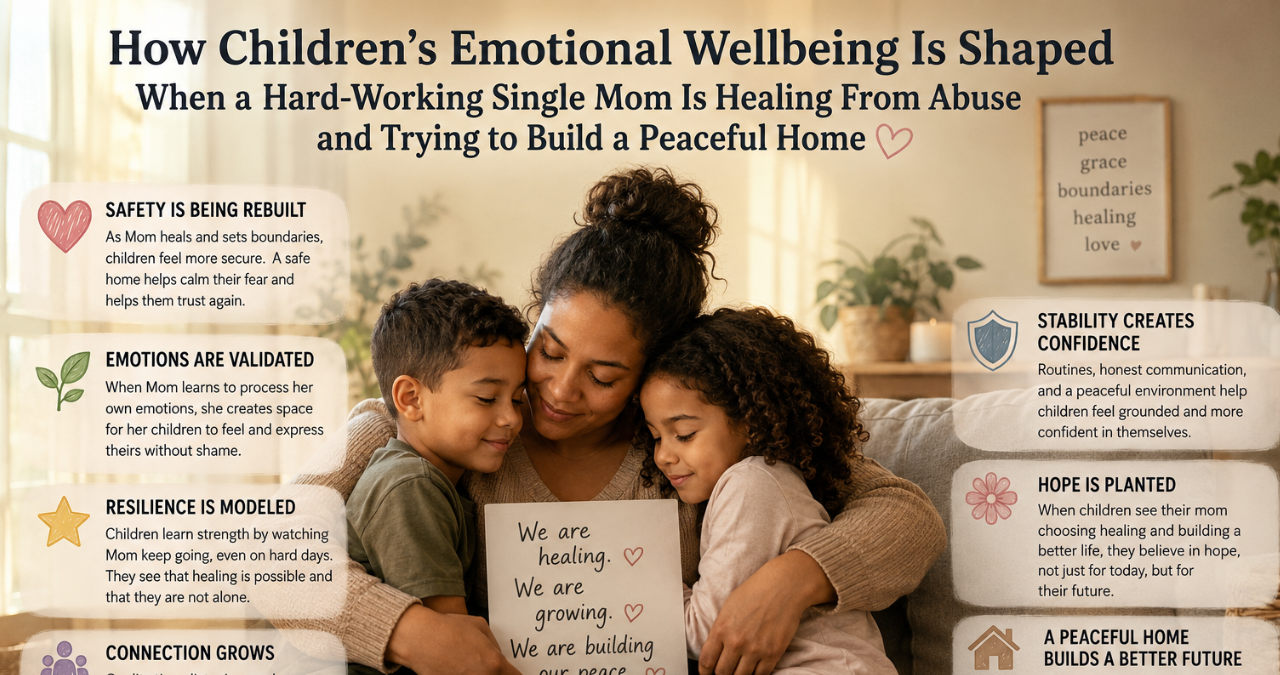
A peaceful home does not always begin as a peaceful place. Sometimes it begins with a mother who is tired, worried, and still trying to recover from things she rarely talks about. She may be working long hours, answering school messages, cooking dinner, paying bills, and trying to hold herself together while her children watch quietly from the background.
For a hard-working single mom healing from abuse, home can feel like both a shelter and a repair site. She is not only rebuilding her own sense of safety. She is also helping her children understand what safety feels like, maybe for the first time in a long while.
Children do not need to know every painful detail to feel the effects of abuse. They notice tension. They hear the tone. They remember slammed doors, cold silences, sharp words, and the feeling of not knowing what mood would enter the room next. Even after the abusive relationship ends, the emotional impact can stay in the home. It can show up in sleep, school focus, behavior, trust, and confidence.
But healing changes the atmosphere.
When a mother begins to create calm routines, speak gently, protect boundaries, and ask for help when she needs it, her children begin to learn a new lesson. They learn that love can be safe. They learn that conflict does not have to mean fear. They learn that home can become a place where their bodies can finally relax.
When Children Carry What They Cannot Explain
Children often carry emotional stress before they have the words to explain it. A child may not say, “I feel anxious because our home used to feel unsafe.” Instead, they may cry over small changes, get angry over simple instructions, cling to their mother, or become quiet in a way that feels heavy.
Some children act older than they are. They try to protect their mother. They listen for adult conversations. They worry about money, arguments, and whether something bad will happen again. Other children go the opposite way. They become restless, defiant, distracted, or withdrawn. From the outside, people may call it bad behavior. But often, it is fear wearing a different outfit.
That is the hard part. Children do not always look hurt when they are hurt. Sometimes they look rude. Sometimes they look lazy. Sometimes they look like they do not care.
In reality, their nervous system may still be on alert.
A child who has lived around abuse may scan faces before speaking. They may freeze when someone raises their voice. They may struggle to sleep because bedtime feels too quiet. They may have stomachaches before school or trouble focusing in class because their minds keep drifting back to home. Their brain is doing what it learned to do: watch for danger.
That kind of stress can affect emotional well-being in deep ways. It can shape how children trust people, how they handle conflict, how they see themselves, and how safe they feel in the world.
A single mom healing from abuse can help by creating a new emotional pattern at home. Not through one big speech, but through steady proof. A calm morning. A predictable bedtime. A clear answer. A warm hug after a hard moment. A simple reminder: “You are safe here.”
Small things matter when fear has taken up space.
A Mother’s Healing Becomes Part of the Home’s Healing
A mother’s healing has a quiet but powerful effect on her children. When she begins to recover, the home begins to recover, too. The change may not be dramatic at first. It may show up in small ways, like fewer tense silences, softer conversations, or more laughter at the dinner table.
Children learn from what they see. When they watch their mother set boundaries, they learn that people are allowed to protect themselves. When they see her ask for help, they learn that support is not shameful. When she apologizes after losing patience, they learn that love includes repair.
This matters because abuse often teaches children confusing lessons. It can make them think love means control. It can make them believe anger is power. It can make them feel responsible for adult emotions. A healing mother slowly teaches the opposite.
She teaches them that love is not supposed to hurt. She teaches them that mistakes can be repaired. She teaches them that a bad day does not have to become a bad home.
Of course, healing is not neat. A single mom may still feel guilt, grief, anger, or exhaustion. She may have days when she snaps too quickly or cries in the bathroom where the kids cannot see. That does not mean she is failing. It means she is human.
What helps children is not perfection. It is honesty, safety, and consistency.
For some families, healing also includes dealing with substance use, trauma, or mental health struggles that developed during or after an abusive relationship. Professional support can make recovery more stable. A resource such as Drug and alcohol rehab in Massachusetts can be part of a wider path for people who need structured help while rebuilding their lives.
When a mother gets support, her children benefit. They see that pain does not have to stay hidden. They see that adults can choose help instead of chaos. That lesson can stay with them for years.
Routines Are Not Boring When Life Has Felt Unsafe
Routines may sound ordinary, but for children who have lived through fear, they can feel like safety in daily form. A regular bedtime, a simple school morning, a weekly grocery rhythm, or a quiet dinner routine can help children feel that life is no longer spinning out of control.
Children need to know what comes next. They need rhythm. They need signals that the house is steady. When life has been unpredictable, predictability feels like comfort.
This does not mean a single mom needs a perfect home. She does not need matching storage bins, expensive planners, or a spotless kitchen. Real life is messier than that. There may be laundry on the chair, cereal for dinner, and homework done beside a pile of unpaid bills.
Still, routine can exist inside real life.
A child can know that shoes go by the door. They can know that bedtime comes after a bath and a story. They can know that Sunday night is when school bags get checked. They can know that when someone gets upset, the family takes a breath and talks when voices are calm.
These patterns may seem small, but they tell the child, “We are okay. We have a rhythm now.”
Calm communication is also part of routine. After abuse, both mother and child may be sensitive to tone. A raised voice can feel bigger than it is. A frustrated sigh can sound like danger. That is why gentle, clear language matters.
Phrases like “You are not in trouble for having feelings,” or “This is an adult problem, and I am handling it,” can help children release burdens they were never meant to carry. A simple “I am upset, but you are safe” can do more than a long explanation.
Children need words that make the room feel steady.
They also need boundaries. A peaceful home is not a home without rules. It is a home where rules are clear and not scary. It is a home where discipline does not rely on fear. It is a home where children know what is expected, and they also know they are loved when they make mistakes.
School, Focus, and Confidence All Connect Back to Safety
A child’s school life is closely tied to what happens at home. When a child feels unsafe, stressed, or emotionally overloaded, learning becomes harder. Their brains are busy managing worry, so there is less room for reading, math, friendships, and classroom rules.
Teachers may notice that the child seems distracted. They may forget homework, struggle to sit still, lose interest in school, or react strongly to correction. Some children become perfectionists because they want control somewhere. Others stop trying because they feel too tired inside.
This is why emotional safety at home matters so much. When a child begins to feel secure, school often becomes easier to manage. They sleep better. They listen better. They have more patience for hard tasks. They start to believe they can try without failing completely.
Confidence grows slowly in children who have lived with fear. It does not always come from big praise. It comes from being noticed in small, honest ways.
A mother saying, “I saw how hard you tried,” can help. So can, “You told the truth, and that matters.” So can showing up to a school meeting after a long shift, even if she arrives tired and carrying a work bag.
Children remember presence.
They remember who came to the classroom event. They remember who signed the form. They remember who asked about their day and actually listened. They remember when home started feeling normal again.
And normal, after chaos, can feel beautiful.
A hard-working single mom may worry that she is not doing enough. But emotional well-being is not built only through big moments. It is built through repeated signs that the child matters. A packed lunch. A bedtime check-in. A calm ride to school. A mother who keeps trying, even when she is tired.
That kind of love builds confidence from the inside out.
Safe Spaces at Home Help Children Feel in Control Again
Abuse can make children feel powerless. Things happened around them that they could not stop. Adults made choices they could not control. Their home, which should have felt safe, may have felt unpredictable.
A safe space at home helps give children a small sense of control back.
This space does not need to be fancy. It can be a corner of the bedroom, a chair near a window, a blanket, a box of crayons, a journal, a few books, or a quiet place where the child can sit when feelings get too big. The goal is not decoration. The goal is peace.
For younger children, this space can help them calm their bodies. For teenagers, a safe space may look different. It may mean privacy, music, journaling, walking outside, or having time alone without being questioned right away.
Parents often want their children to talk. That makes sense. A mother may worry when her child shuts down. But sometimes presence works better than pressure. Sitting nearby, keeping the door open emotionally, and saying, “I am here when you are ready,” can mean a lot.
Safe spaces also exist outside the home. A trusted teacher, school counselor, coach, neighbor, relative, therapist, or support group can become part of a child’s support circle. Children need to know there are safe adults beyond their mother, too.
This does not replace the mother’s role. It strengthens the family.
For families dealing with emotional stress, trauma, or substance-related challenges, structured care can support stability while daily life continues. A Sacramento intensive outpatient program can help people receive care while still managing school, work, and family responsibilities.
Support does not mean the family is broken. It means the family is being protected.
And honestly, single moms should not have to carry the whole load alone.
The Single Mom’s Workload Is Part of the Story
It is impossible to talk about healing without talking about work, money, and exhaustion. Many single moms are trying to build peace while also trying to survive. They may work long shifts, take extra hours, manage childcare, stretch groceries, and answer school messages during lunch breaks.
Healing sounds gentle when people talk about it from the outside. In real life, it can happen in a car between errands, in a break room, in the shower, or at midnight after the kids are asleep.
That kind of pressure affects the whole home.
Children can sense financial stress. They may notice when their mother skips meals, worries over bills, or says no to small things because money is tight. Some children begin hiding their needs because they do not want to add more stress. A child may avoid asking for school supplies, new shoes, or help with a project because they already know mom is tired.
This is why practical support matters. Emotional healing is harder when survival takes every bit of energy.
Food support, childcare help, school resources, flexible work options, legal aid, and safe housing can all affect a child’s emotional well-being. Peace at home is not only about soft voices and bedtime routines. It is also about having enough stability to breathe.
A mother needs rest, too.
Many hard-working single moms feel guilty when they rest. They feel like sitting down means something is being neglected. But rest is not laziness. Rest helps the nervous system settle. It helps a mother respond instead of react. It helps her laugh again.
And children need that laughter.
A peaceful home is not always quiet. There will still be sibling arguments, rushed mornings, spilled juice, lost socks, and homework drama. That is normal family life. The difference is that fear is no longer in charge.
That difference changes everything.
Healing Builds a New Family Story
Abuse can leave children with painful questions they may never say out loud.
Was it my fault?
Will it happen again?
Can I trust people?
Is love safe?
A mother’s healing helps answer those questions through daily action. She may not have the perfect words every time, but her choices speak. Leaving danger speaks. Creating rules speaks. Going to work and coming home with love speaks. Asking for help speaks. Apologizing after a hard moment speaks.
Bit by bit, the family story changes.
The story is no longer only about fear. It becomes about repair. It becomes about courage. It becomes about a mother who fought to build something softer for her children.
Some families need extra care along the way. Trauma, anxiety, depression, substance use, and chronic stress can overlap after abuse. When mental health and addiction concerns are part of the picture, support from services such as Addiction and mental health treatment in Massachusetts can help families find steadier ground.
The goal is not to label a mother or child as damaged. The goal is to give them tools, care, and a way forward.
Children are deeply shaped by home, but they are also deeply shaped by healing. A child who has lived through fear can still learn trust. A child who has felt unsafe can still grow confident. A child who has seen pain can still believe in kindness.
That belief begins with repeated proof.
A safe bedtime. A calm answer. A warm meal. A mother who says, “We are okay,” and then keeps building a life that makes those words feel true.
Final Thoughts: Peace Is Built in Small, Repeated Ways
A child’s emotional well-being is shaped by the home they live in, the words they hear, the routines they follow, and the safety they feel in their body. When a hard-working single mom is healing from abuse, her healing becomes part of her child’s healing, too.
No, the process is not perfect. Some days will feel heavy. Some mornings will start badly. Some nights will end with tears. Healing can be messy because families are not machines. They are people. Tired people. Hopeful people. People are trying again after life has been hard.
But peace is not built all at once.
It is built in small, repeated ways. Through calm communication. Through routines. Through safe spaces. Through support. Through a mother choosing repair over fear, again and again.
For children, that steady love can become the ground beneath their feet.
And for a single mom who has survived abuse, building a peaceful home is more than daily parenting. It is protection. It is healing. It is a new beginning that her children can feel, even before they fully understand it.
Stay in touch to get more updates & news on Us Daily Hub!