
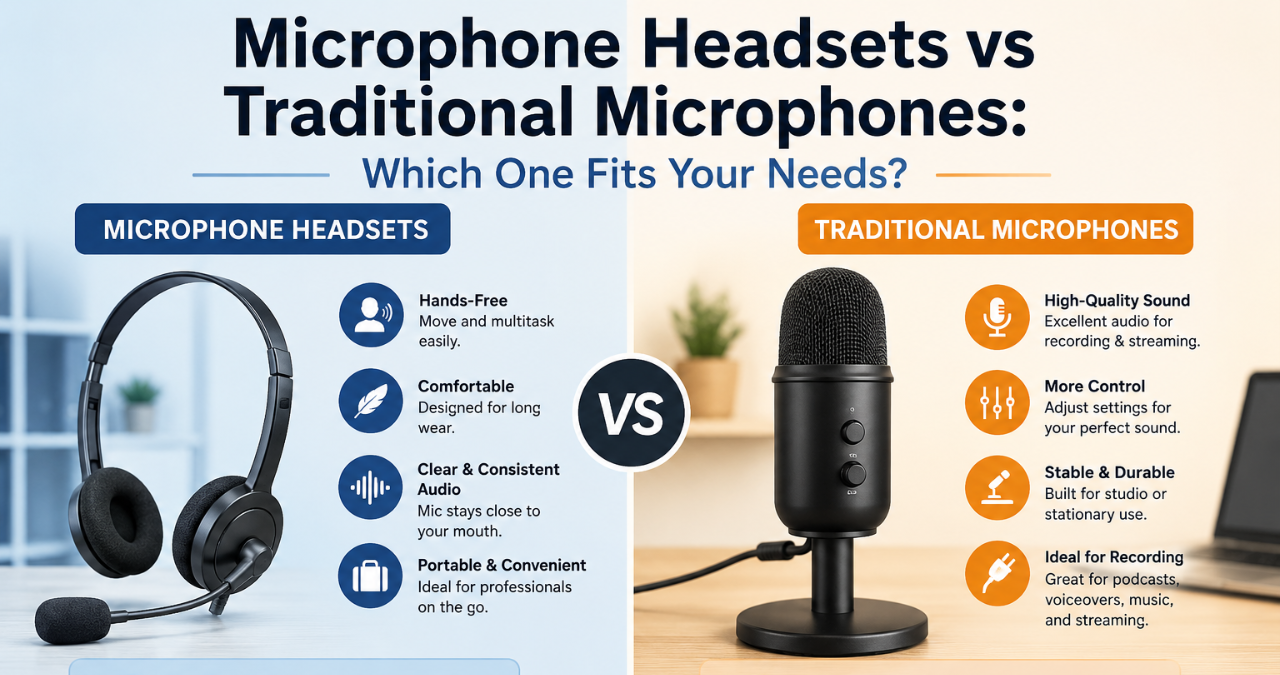
Pick the wrong mic and your whole recording sounds off. That choice matters more than people think. Microphone headsets solve some problems. Traditional standalone microphones solve different ones. Neither wins every fight. This article breaks down exactly where each one shines, using real differences in build, sound capture, and use case, so you stop guessing and start picking the right tool for your actual situation.
What Makes These Two Mic Types Different?
A headset mic stays fixed near your mouth no matter how you move your head. A traditional microphone, whether handheld or a standalone desk mic, stays in one spot in space while you move around it. That single difference changes everything else. Headset mics keep your volume level steady because the distance to your mouth never changes. Traditional mics need you to stay in position, or your volume swings up and down as you shift closer or farther away. For anyone who talks while moving, gestures, or walks around a stage, that consistency is the headset’s biggest advantage.
Which One Sounds Better In A Quiet Room?
Traditional standalone microphones usually win here, and it is not close. A studio condenser mic often uses a much bigger capsule than anything packed into a tiny headset boom. Bigger capsules generally capture more detail, more low end warmth, and a wider frequency range. A headset mic squeezes its capsule into a small housing near your cheek, which limits how much sound detail it can grab. If you are recording a podcast alone in a treated room with no movement, a standalone mic gives you a cleaner, richer signal every time.
Which One Handles Movement And Noise Better?
This flips entirely in favor of headsets. Once you add movement, crowd noise, or distance from a fixed mic stand, traditional microphones start to struggle. A standalone mic on a stand cannot follow you across a stage. A handheld mic ties up one of your hands the entire time. A headset mic moves exactly where your head moves, so a teacher pacing a classroom, a fitness instructor leading a class, or a performer dancing across a stage all stay audible without holding anything or standing still. Background noise also matters less here because the headset stays close to your mouth at a fixed, short distance.
What About Setup And Convenience?
Headset mics win on speed. Put it on, adjust the boom, and you are recording or speaking within seconds. Traditional mics, especially studio condensers, often need a stand, a pop filter, an audio interface, and careful room placement to sound their best. That setup takes real time and real gear. For someone recording a quick voiceover at a desk, a standalone USB mic still wins because setup happens once and stays put. For someone presenting live to a moving crowd, that same fixed setup becomes a problem the moment they step away from the desk.
Which One Should You Actually Buy?
Match the mic to the task, not to what sounds more professional on paper. Choose a headset mic for live presentations, fitness classes, call center work, gaming, and anything involving constant head or body movement. Choose a traditional standalone microphone for podcasting from a fixed seat, studio vocal recording, voiceover work, and any situation where you control the room and stay still. Plenty of professionals own both and switch based on the job that day. The mistake is assuming one type fits every situation, when the honest answer is that movement and environment decide the winner almost every time.
Stay in touch to get more updates & news on Us Daily Hub!