
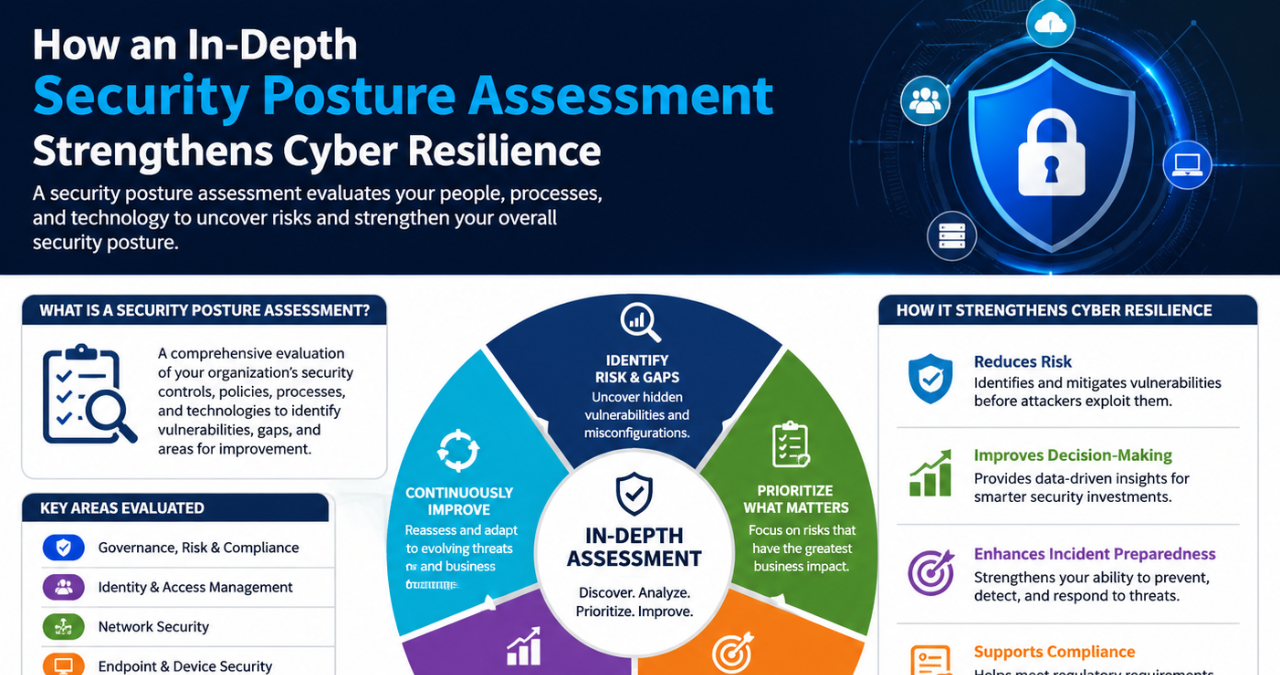
Cyber resilience is not about building walls. It is about knowing exactly how exposed you are and having a tested plan when something gets through. Most organisations overestimate how well their controls actually work. An In-Depth Security Posture Assessment cuts through that overconfidence with evidence. According to Gartner, by 2026, organisations that conduct regular posture assessments will experience 60 percent fewer high-impact security incidents than those that do not. That gap is not a coincidence. It is the direct result of knowing versus assuming.
What Does a Security Posture Assessment Actually Measure?
Your security posture is the collective strength of your defences across every dimension.
It covers identity controls, network architecture, endpoint protection, data security, application security, backup integrity, and incident response readiness. Each area gets evaluated against both technical benchmarks and real-world threat scenarios. This is not a compliance checklist. It is a threat-informed evaluation.
Assessors map your environment against frameworks like NIST CSF, CIS Controls, and the Australian Cyber Security Centre’s Essential Eight. They look at your detective controls, not just your preventive ones. Many organisations have decent firewalls but almost no ability to detect lateral movement after an attacker gets inside.
The output is a clear picture of your attack surface, your detection blind spots, and the specific paths an attacker could use to reach your most valuable assets. That picture is what enables meaningful action.
How Does a Posture Assessment Differ From a Penetration Test?
They serve different purposes and people often confuse them.
A penetration test asks: can an attacker get in? It simulates active exploitation to find vulnerabilities. It is valuable. It is also narrow. A successful pen test only tells you about the specific paths tested on a specific day.
A security posture assessment asks a bigger question: how strong are all of your defences? It evaluates the depth and consistency of your controls across your entire environment. It finds systemic weaknesses, not just individual exploitable vulnerabilities.
Think of a pen test as checking if one particular door is locked. A posture assessment checks every door, window, and air vent while also asking whether you have cameras, alarms, and a response plan. Both matter. But if you can only do one, the posture assessment tells you more about your actual risk exposure.
What Are the Key Pillars of a Strong Security Posture?
Resilience is built on five interconnected capabilities.
Visibility comes first. You cannot defend what you cannot see. This means complete asset inventory, comprehensive logging, and continuous monitoring across cloud, on-premises, and endpoint environments. Organisations without full visibility are flying blind.
Control effectiveness is the second pillar. Having a firewall is not the same as having a firewall configured correctly. Assessment validates that controls are not just present but actually working as intended.
Detection speed matters enormously. The average dwell time for attackers in enterprise networks was 16 days in 2023 according to Mandiant’s M-Trends report. Every day an attacker spends undetected is another day they spend gathering credentials, mapping systems, and staging payloads.
Response readiness and recovery capability complete the picture. Backups that have never been tested are not backups. Incident response plans that have never been exercised are not plans. Posture assessments validate these capabilities, not just their existence.
Which Industries Benefit Most From Regular Posture Assessments?
Every industry with sensitive data benefits. Some face existential risk without them.
Healthcare organisations hold some of the most sensitive data in existence. The average healthcare data breach cost $10.93 million in 2023 according to IBM, the highest of any industry. Posture assessments in healthcare focus heavily on medical device security, legacy system exposure, and HIPAA or Australian Privacy Act compliance.
Financial services organisations face sophisticated, persistent attackers. Regulatory frameworks including APRA’s CPS 234 in Australia explicitly require organisations to regularly assess their information security capabilities. A posture assessment is a core part of meeting that obligation.
Critical infrastructure operators, including utilities and logistics companies, face nation-state level threats. For these organisations, a posture assessment is not optional. It is baseline operational security.
How Do You Turn Assessment Findings Into Actual Security Improvement?
Findings are only valuable if they drive action. Most assessment programmes fail at this step.
The first requirement is executive sponsorship. Security posture cannot improve without budget and authority. Assessment findings need to reach the board or C-suite in business language, not technical jargon. Frame every finding in terms of business risk. A misconfigured identity system is not an IT problem. It is a $4 million problem.
Second, build a remediation programme with milestones, owners, and deadlines. Assign every critical finding a named owner and a 30-day target. Medium findings get 90 days. Everything gets tracked.
Third, reassess after remediation. Point-in-time assessments that are never followed up are wasted investment. Periodic reassessment measures progress and keeps your security posture improving rather than decaying. Security is not a destination. It is a continuous process.
Stay in touch to get more updates & news on Us Daily Hub!