
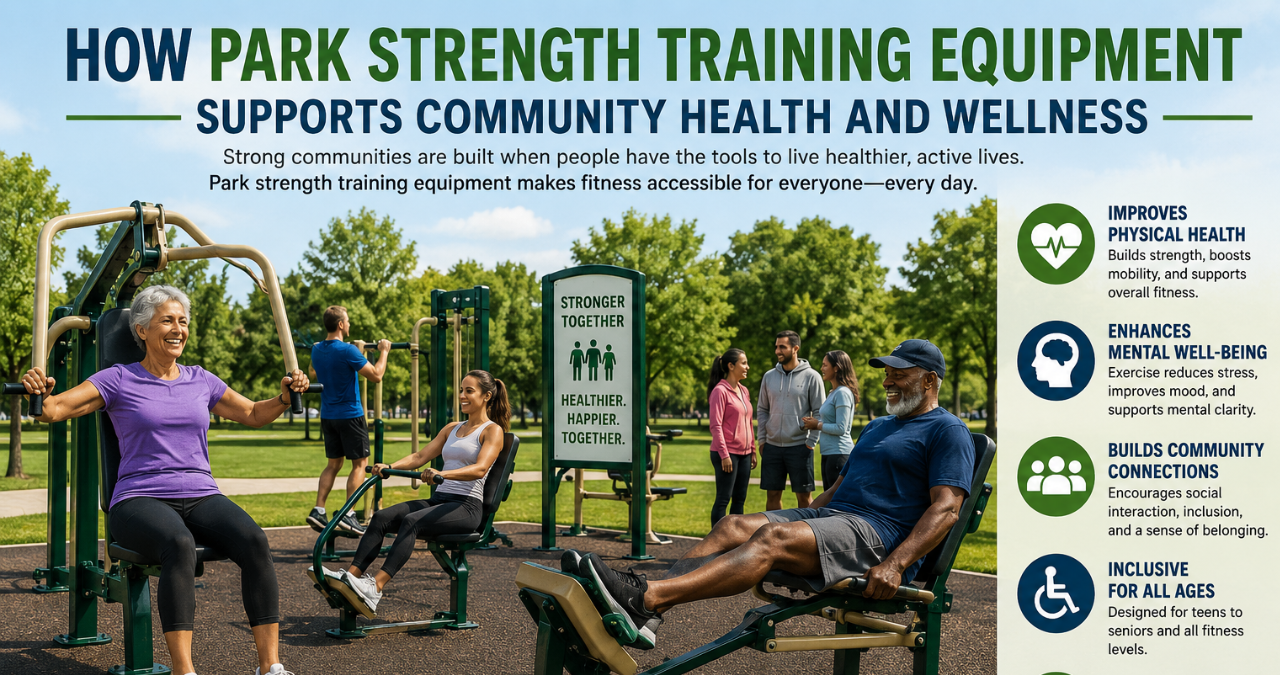
Strength training is not just for athletes. It is for everyone. Muscle mass declines by 3 to 5% per decade after age 30. That decline accelerates after 60. Weak muscles mean falls, fractures, metabolic disease, and dependency. Park strength training equipment places the solution directly in the community. Pull-up bars, push-up stations, dip bars, leg press units, and resistance machines built for outdoor use give people of all ages a free, accessible path to musculoskeletal health. Research from the British Journal of Sports Medicine shows that muscle-strengthening activities twice per week reduce all-cause mortality by 23% and cardiovascular disease risk by 17%. Public parks are the most democratic venue for making that happen.
What Happens to the Body Without Strength Training?
Sarcopenia is the medical term for age-related muscle loss. It starts earlier than most people think. By age 40, most sedentary adults have already lost measurable lean muscle mass. By 70, untreated sarcopenia compromises balance, metabolic function, and bone density. The flow-on effects include type 2 diabetes risk, osteoporosis, and a significantly higher rate of falls. Falls are the leading cause of injury-related death in Australians over 65.
Resistance training directly reverses sarcopenic progression. It stimulates muscle protein synthesis, increases insulin sensitivity, improves bone mineral density, and enhances neuromuscular coordination. The problem is not the science. The problem is access. Park strength equipment solves the access problem at scale.
How Does Outdoor Strength Equipment Compare to Gym Machines?
Honestly, for functional strength, outdoor bodyweight-based equipment often wins. Commercial gym machines are designed for muscle isolation in controlled ranges of motion. That builds aesthetics. Outdoor pull-up bars, parallel bars, and push-up stations build functional strength by requiring stability, coordination, and proprioceptive engagement alongside raw force output. A 2020 study in the Journal of Strength and Conditioning Research found that calisthenic training on outdoor equipment produced equivalent upper body strength gains to machine-based training over 12 weeks, with superior improvements in muscular endurance and body control.
For older adults and beginners, the adjustability of body weight as resistance is particularly valuable. A person can reduce load by changing angle, grip width, or range of motion. No pin to pull. No setting to adjust. Just the body and the bar.
What Makes Outdoor Strength Equipment Safe for All Users?
Safety in outdoor strength equipment comes down to three things: structural integrity, surfacing, and design for diverse users. Structural integrity means load ratings far exceeding any realistic single-user scenario. Commercial pull-up bars must be rated for dynamic loading, the additional force created when a user swings or kips, not just static hanging weight. That rating is typically 200 to 300% of the standard static load.
Surfacing beneath strength equipment must attenuate falls from the highest reachable point. Rubber crumb tiles at 40mm thickness or engineered wood fibre at 300mm depth are both acceptable solutions under Australian Standards. Design for diverse users means considering grip diameter for older hands, step assistance for shorter users accessing high bars, and seated options for users with lower body limitations.
What Does Community Strength Equipment Do for Social Health?
Parks are not just fitness spaces. They are social infrastructure. A well-designed outdoor gym creates a reason for people to be outdoors, to see neighbours, to interact with strangers in a low-stakes context. Research from the University of Queensland found that parks with outdoor fitness equipment showed a 34% increase in adult visitation frequency and a significant increase in social interactions between users compared to parks without equipment.
Loneliness and social isolation are classified as public health crises in Australia. Their health impact is comparable to smoking 15 cigarettes per day. An outdoor gym in a park is not going to solve loneliness alone. But it creates a shared space with a shared purpose. That is where community starts.
How Does Strength Equipment Serve Older Adults Specifically?
Exercise guidelines from both the Australian Government and WHO recommend muscle-strengthening activities at least twice per week for adults over 65. Most do not meet that guideline. The barriers are cost, transport, and gym intimidation. Outdoor strength equipment in local parks removes all three. A 2021 study from Monash University found that older adults who used park-based strength equipment twice weekly for 16 weeks showed significant improvements in grip strength, chair stand speed, and balance test scores. All three are clinical markers for fall risk and independent living capacity.
What Does Good Outdoor Strength Equipment Planning Look Like?
The most effective installations are planned around user diversity from the start. Multi-height pull-up bars serve both tall adults and shorter users and children. Combination units that offer push, pull, and leg press movements in a single footprint maximise the training value per square metre. Instructional signage with clear body position diagrams and difficulty progressions increases correct usage and reduces injury. Spacing between units of at least 1.5 metres ensures safe movement. And co-locating strength and cardio equipment in a defined outdoor gym zone creates a destination, not just a scattered collection of metal bars.
Stay in touch to get more updates & news on Us Daily Hub!