
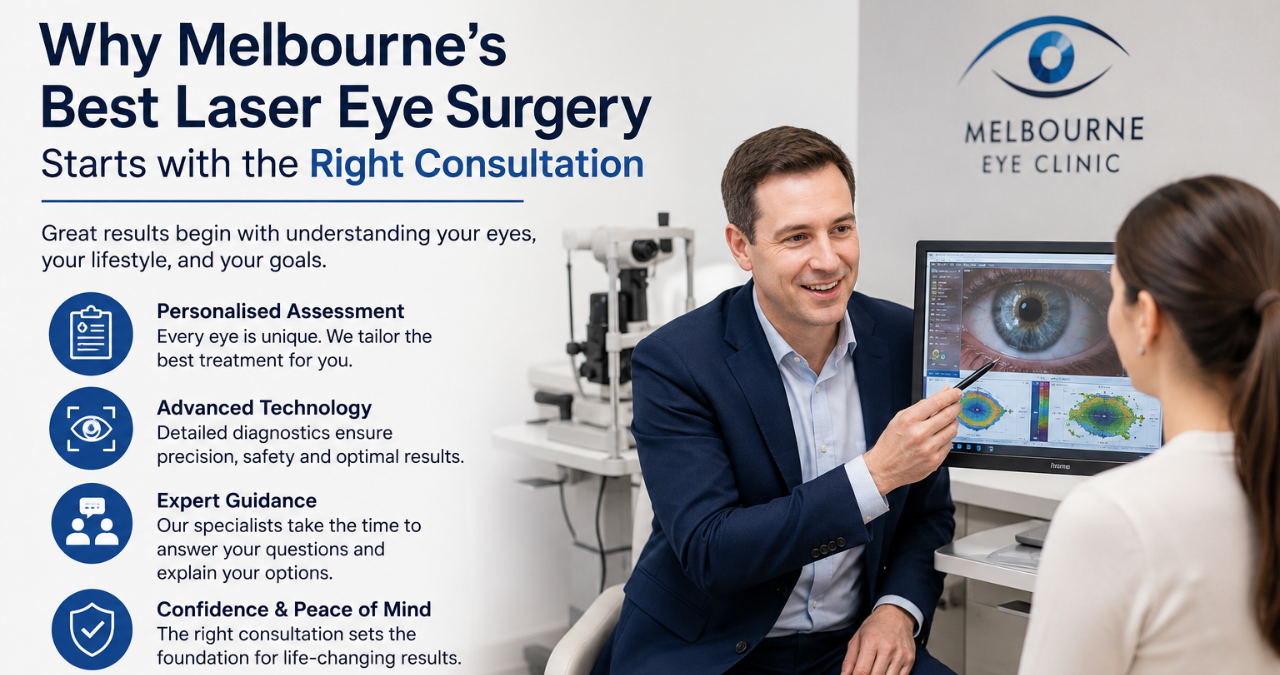
The consultation is not a formality. It is the most important part of the entire laser eye surgery process. According to the American Academy of Ophthalmology, most complications from refractive surgery are the result of poor patient selection, not surgical error. That happens at the assessment stage. If you are serious about finding Melbourne’s best laser eye surgery, then the quality of the consultation should be your first filter, not your last. What happens in that room determines everything.
What Happens During a Laser Eye Surgery Consultation?
A genuine consultation starts with a full history. The surgeon or technician will ask about your current prescription, how long it has been stable, your medical history, any autoimmune conditions, and what medications you take. Some medications increase dry eye risk. Some medical conditions contraindicate surgery entirely.
Then comes the testing. Corneal topography maps every millimetre of your cornea surface. The minimum safe corneal thickness for LASIK is around 500 microns. Going below that creates instability risk. Wavefront aberrometry captures the unique way your eye bends light. This data feeds directly into how the laser is calibrated on the day of your procedure.
Why Is Corneal Mapping So Critical?
Your cornea is not a perfect dome. Everyone has irregularities. Most are harmless. But some, like keratoconus, make laser surgery dangerous. Keratoconus is a condition where the cornea progressively thins and bulges forward. It affects roughly 1 in 2,000 people globally, though some studies suggest the prevalence is higher in Australia.
If a surgeon operates on a cornea with early, undetected keratoconus, the surgery can accelerate the condition and cause severe visual distortion that glasses cannot correct. Corneal topography and tomography together can detect even mild, subclinical keratoconus. This is why the assessment cannot be rushed. A 15-minute scan can prevent a lifetime of complications.
How Do You Know If the Surgeon Is Making a Real Recommendation?
A good surgeon will tell you if you are not a candidate. That is actually the most reassuring thing a surgeon can say when the data does not support surgery. A clinic that tells every patient they qualify is not being thorough. It is being reckless.
The consultation should result in a clear recommendation with a rationale. Which procedure and why. What your expected outcome range is. What your risk profile looks like based on your specific measurements. If you leave the consultation without understanding these three things, ask more questions or seek a second opinion.
What Questions Should You Ask at the Consultation?
Ask how many procedures the surgeon has personally performed. Ask what technology they use and why they chose it. Ask what the complication rate is at their clinic, not the industry average. Ask what happens if your vision regresses after surgery. Ask what the follow-up schedule looks like for the first 12 months.
A surgeon who welcomes these questions and answers them clearly is a surgeon who is confident in their work. Deflection or vague answers about complication rates or retreatment policies should make you pause. Informed patients get better outcomes. The consultation is where you earn that information.
What Should a Second Opinion Tell You?
Getting a second consultation is smart. Not because the first surgeon is necessarily wrong, but because comparing assessments gives you confidence. If two experienced surgeons independently agree on the procedure and your candidacy, you can proceed with far more certainty.
A second opinion also gives you a price comparison point. Not to drive the price down, but to understand market positioning. The cheapest option and the most expensive option are both worth scrutinising. The middle of the Melbourne market for quality LASIK typically sits between AUD 2,800 and AUD 3,800 per eye with full aftercare included. Price outside that range in either direction deserves an explanation.
Stay in touch to get more updates & news on Us Daily Hub!